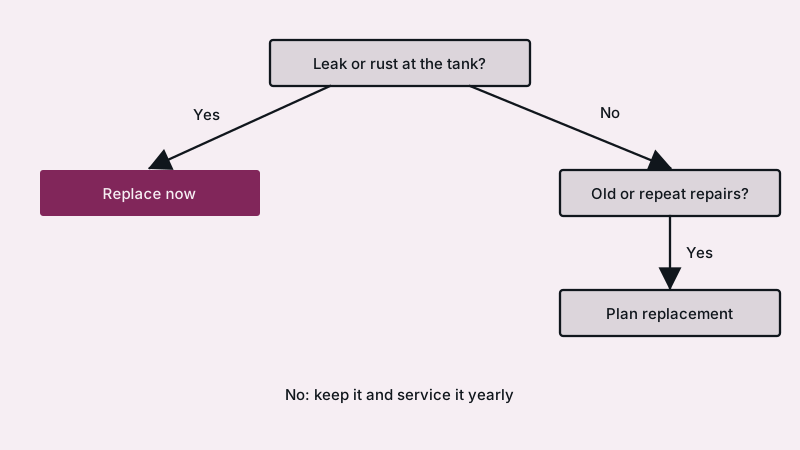
There is no single date. Storage tank heaters are commonly quoted at roughly eight to twelve years, and tankless units at a longer span, but water chemistry, how hard the heater works and how it was installed move that either way. Use age as a prompt to look closely, and let leaks, rust and repeat repairs make the call. For the repair angle, see water heater repair.
Where do I read my heater's age?
The data label stuck to the tank carries it. The build date sits inside the serial number, frequently a month letter then a two-digit year, though each brand has its own scheme. Try the brand name plus "serial number date" or ask the plumber, who decodes these constantly. It shows manufacture, not installation, so allow for some shelf time.
If the plate is unreadable, look for a permit or an invoice dated when the heater went in. Your home's building records at the city may hold the permit, and Building Services at 949-470-3054 can say whether they keep one for your address.
Which signs say it is time to replace, not repair?
Water on the floor that traces to the tank itself, rust-colored hot water from the tap only, a base streaked with rust, and a tank that rumbles for months despite flushing are the stronger signals. Add age past ten years and a second repair inside a short span, and replacement usually wins.
Put the signs in order of weight:
- Leak from the tank body. No repair exists.
- Corroded fittings and rust at the base, which hint at a tank wall about to give.
- Rusty hot water with clean cold water.
- Sediment noise that a flush no longer clears.
- Lukewarm output with new elements or a new burner already fitted.
- A heater past its labeled age with a history of repairs.
What a swap involves is laid out in replacement pricing; weigh that against repair.
Does flushing a ten-year-old water heater help or harm?
It usually helps if the heater has been flushed before, and it can backfire if the tank never has been. Years of hardened sediment can plug the drain valve, and disturbing it may leave the valve dripping afterward. Many plumbers advise a gentle flush on an older unit and warn that leak risk is real. A flush is not a repair for a failing tank.
If you do flush, turn off gas or power first, let the water cool, attach a hose, open a hot tap upstairs so air enters, and drain until the water runs clear. Hard water speeds scale; ask your water district for its hardness figures to understand your own conditions.
What yearly service does a tank heater need?
Once a year is the usual advice. Raise the relief valve lever for a second to confirm it moves and reseats (keep clear, the discharge is hot), look for drips and corrosion, inspect the vent and the gas flame, and run a few quarts out of the drain. Swap the anode once its steel core is mostly bare; hard water can bring that on within a few years. See anode rod replacement.
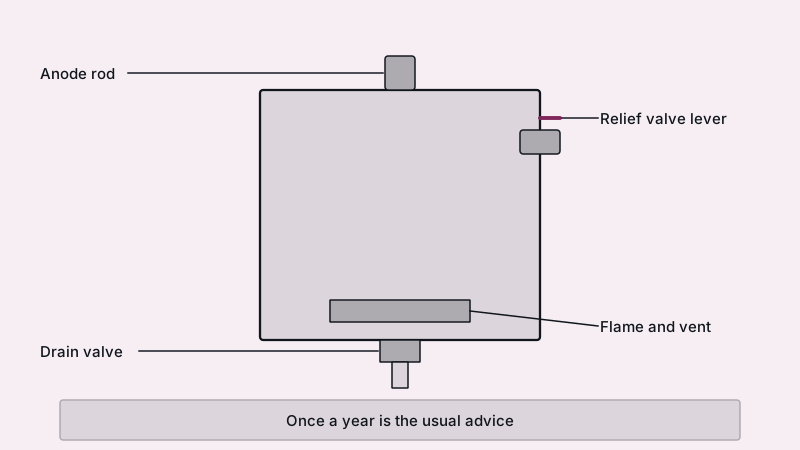
Check your manual, since the maker's schedule takes priority. A plumber can do the whole round in a short visit, and a stuck or dripping relief valve is cheap to change; the guide to relief valve replacement covers it.
What shortens or stretches a heater's life?
Hard water and sediment shorten it. A spent anode rod shortens it. High water pressure and a closed system with no expansion tank wear tanks and valves through repeated pressure spikes, a point the city's handout touches on when it requires an expansion tank in closed systems. Garage heaters sit in dust and lint, which clogs burners.
Stretching it takes the opposite: routine flushing, a fresh anode, a working expansion tank (see expansion tank replacement), and a pressure reading on the house supply. Lower thermostat settings also reduce scale and standby wear.
Should the next heater be tank or tankless?
A tank that has run its course is the moment to weigh alternatives. Tankless costs more to buy, wants a gas line and vent of the right size, and benefits from descaling where water is hard. A tank is cheaper to buy and simpler to swap. Choose on your household's hot water use, space and budget, not on what the neighbor chose.
Our tank versus tankless comparison sets them side by side. If the heater merely went cold, try the quick checks on no hot water first.
Does replacing a heater bring code upgrades with it?
It can. Mission Viejo's handout lists today's requirements for new and replacement gas heaters: earthquake strapping, a drain pan, an access opening, a sediment trap, and an expansion tank when the supply is closed. A new unit must meet them even if the old one did not. Permits are a city matter, discussed under plumbing permits for heaters.
Replacement work is contractor work, and the CSLB's lookup is where you confirm a number before signing.
Common questions
Is a heater at ten years always due for replacement?
No. Some run well past that mark and some fail earlier. Age is one clue among several. A heater at ten with no leaks, clean water and a recent anode swap is a candidate for continued use. The same heater with rust, repeat repairs and noise is a candidate for replacement. Judge by condition.
Do tankless heaters last longer?
The expectation is that they outlive tanks, often by years, provided they get descaled and serviced. Hard water is the main enemy: scale coats the heat exchanger and error codes follow. Check the maker's warranty terms, and ask a plumber how often your water calls for descaling.
Will a fresh anode rod buy more years?
Often, if the tank wall is still sound. The rod is built to be eaten away so the steel is spared. Once it is gone, the tank wall takes the attack. Replacement every few years helps, though a tank that already shows rust at the seams is past saving. Space above the heater can limit access.
Does someone need to be there for the swap?
An adult should let the plumber in, point out the heater and shutoffs, and look over the finished job. Expect water and gas to be off while work proceeds. A garage heater needs a clear path and floor space. Mention access when you send a price request.
This guide is one of many on plumber in Mission Viejo.
Sources
Updated