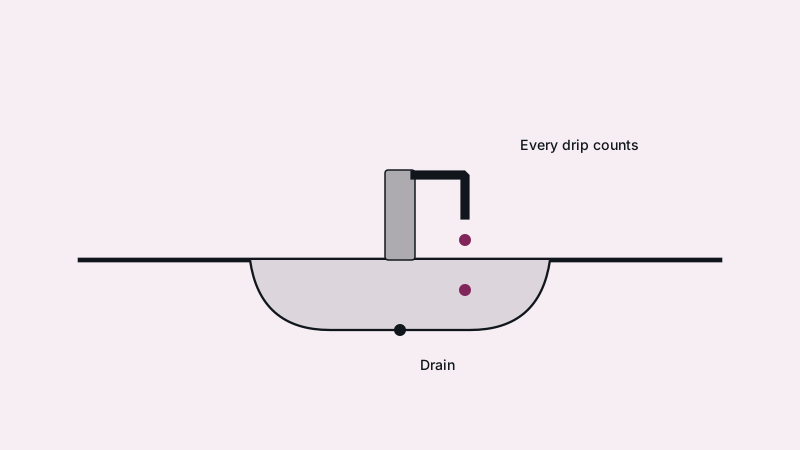
Yes, but usually only a little. EPA's arithmetic for a tap that drips about once every second is over three thousand gallons across a year, which is real water yet small beside what a household normally uses. If your bill has doubled, a faucet is rarely the reason. Check the toilets, the sprinklers and the pipes you cannot see. The faucets, sinks and disposals hub covers the fixtures themselves.
How much does one dripping faucet add to the bill?
EPA's drip figure is over three thousand gallons across a year for a tap that releases a drop every second. A shower head dripping ten times each minute loses more than five hundred. These are small numbers beside normal household use, and a worn washer or cartridge costs little to fix.
Perspective helps. Across every kind of leak, EPA puts the typical home's yearly loss above 9,300 gallons, and roughly one house in eleven drips away fifty gallons or more daily. A drip sits at the small end of that range. Repairing the easy leaks can trim a bill by about a tenth, so a drip is worth fixing, just not worth blaming for a big spike.
| Source of loss | What EPA reports |
|---|---|
| Tap dripping every second | Above three thousand gallons per year |
| Shower head, ten drips a minute | Above five hundred gallons per year |
| All leaks in a typical home | Above 9,300 gallons per year |
| About nine percent of homes | Fifty gallons or more daily |
Why is my bill high when the faucet only drips?
Something else is probably running. Candidates in order: a toilet quietly refilling its tank, a sprinkler zone that never closes, a cracked yard line, or extra demand from visitors, a pool fill or a hot, thirsty month. The faucet is the smallest item on that list.
Take them in order of likelihood. EPA says household leaks can waste 180 gallons a week and that toilets are often the culprit, usually through a tired flapper. Sprinkler timers and drip lines come next, and in a Southern California yard they are common. Hidden pipe leaks, buried in the floor or inside a wall, come last but cost the most. The fuller checklist lives in our high water bill article.
What can my water meter tell me about leaks?
With every fixture and appliance idle, copy the meter number, leave the house alone for a couple of hours, and compare. A different number means water is escaping. A spinning dial or triangle on the meter with nothing running tells the same story. EPA describes this two-hour check.
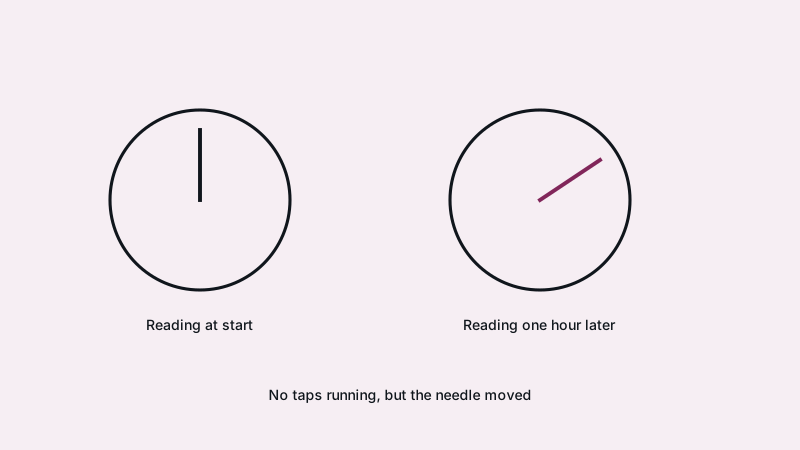
Then narrow it down. A toilet can be tested with a few drops of dye in the tank. Dye in the bowl ten minutes later gives the flapper away. Flush once afterward so nothing stains. For the yard, turn off the irrigation controller and repeat the meter check. A still meter points the finger at the sprinklers. A meter that still creeps places the leak in the house line or underground, work for a plumber's locator gear.
Mission Viejo is not served by one water district. The City's utility page lists El Toro Water District, Moulton Niguel Water District, Santa Margarita Water District and Trabuco Canyon Water District, so the bill in your hand tells you whom to ask about the meter.
How do I stop a faucet from dripping?
Start at the little valves under the basin. Close them, stopper the drain so no screw goes down it, take the handle off and exchange the worn part. Wikipedia explains that modern faucets often hold a replaceable cartridge, while older ones press a rubber washer onto a seat, and many also have O-rings. Buy an exact match, rebuild, then reopen the valves slowly.
The sequence:
- Turn both stop valves clockwise, then run the faucet empty.
- Pop off the cap on the handle, remove the screw beneath, and pull the handle free.
- Pull out the cartridge, or back out the stem if yours is the washer kind.
- Fit the new cartridge, or a new washer and O-ring.
- Rebuild, open the stops slowly and look under the sink for drips.
Moisture around the spout base, or a pool inside the cabinet, usually points to a failed O-ring or a loose supply fitting. The leaky faucet repair and sink faucet guides show each type step by step.
When is a new faucet better than a repair?
Choose a new faucet when the body is corroded, replacement parts have disappeared, or repeated repairs keep failing. A cartridge swap is the cheaper path and a new faucet the final one. The faucet replacement cost article gives the ranges for both jobs.
A plumber we arrange can handle either and write the price down first. If the faucet is sound and the bill is still strange, ask the visitor to hunt for a hidden leak, since finding a buried line leak saves far more than any faucet. Request a visit and mention the meter readings you took.
What does a hidden leak look like on the bill?
Expect higher use each month, even in weeks when nobody was home, and little change with the seasons. EPA gives one benchmark: if a four-person household uses above twelve thousand gallons in a winter month, serious leaks are possible. Compare this month with the same month last year.
More clues: the sound of flowing water in a silent house, a warm or damp floor, softer pressure and a musty smell. Each hints at a pipe you cannot see, behind a wall or beneath concrete. The leak plumber page explains what a plumber does next. Many neighborhoods here were built from the 1960s to the 1990s, so older copper can start pinholing.
Common questions
Is repairing one dripping tap going to shrink the bill?
Only slightly. For a once-a-second drip the saving is modest, and it shows up more clearly when several small leaks are fixed together. EPA's estimate is that curing the easy leaks in a home trims a bill by about ten percent, so it is worth doing but not a cure for a spike.
Does an outdoor spigot leak cost more than an indoor one?
It can. A hose bib with a tired washer, or a hose left half open, loses water out of sight, and a hose can use far more than a drip. Remove the hose and run the meter test. A split in the wall behind the spigot is a plumber's repair. Our outdoor faucet guide shows the basics.
How do I tell a faucet drip from a supply pipe leak?
Dry everything, then watch. Drips from the spout point to the cartridge or washer. Water on the cabinet floor or around the valves points to a supply line, a fitting or the drain. Wrap tissue around a joint, and if it darkens, that joint is the leak.
Does a shower that drips count too?
Yes. A worn shower cartridge lets water escape through the head or inside the wall, and EPA's figure for ten drips a minute is above five hundred gallons a year. If the drip stops when the shower's own stop valve is shut, the cartridge is the likely culprit.
For the wider picture, start with plumber mission viejo.
Sources
Updated