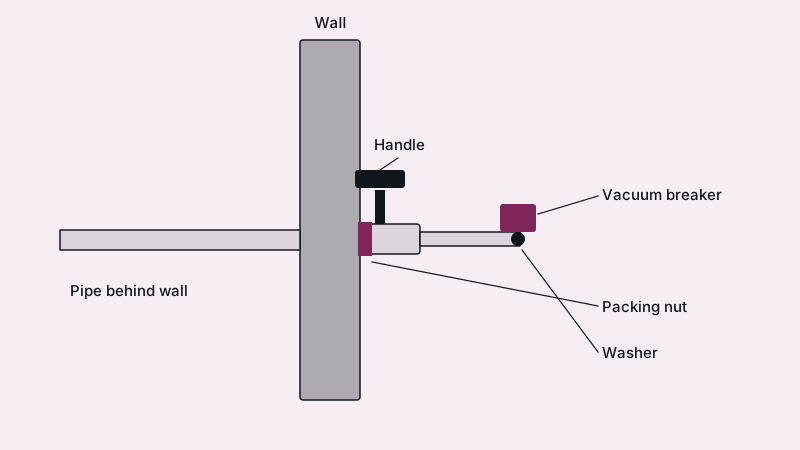
Outdoor faucets, called hose bibs or spigots, fail in three places: around the handle stem, from the spout, and behind the wall. The first two are small repairs with a wrench and a few dollars of parts. The third is a pipe problem. Watch where the water first appears with the hose off and the handle closed, then jump to the section below that matches. General sink and tub faucet fixes are covered in the wider faucet, sink and disposal repair pages, and this one stays outside.
Which spot is the water coming from?
Wipe the spigot dry, close the handle and wait. Dampness around the handle stem is a sign of worn packing. A drip off the spout means a tired washer or seat. Streaks down the wall, or a damp patch inside near the pipe, mean a failed joint or stem behind the wall, and that takes more than a wrench.
| First sign | Likely cause | Who fixes it |
|---|---|---|
| Wet around the handle stem | Packing nut loose or packing worn | You, in minutes |
| Drip from the spout when closed | Washer or seat worn | You, with a stem kit |
| Water spraying from the vacuum breaker cap | Breaker worn or stuck | You, replace the part |
| Leak behind the wall, dark stain inside | Pipe or stem failure | A plumber |
Switch the water on and off to learn whether the leak shows only under pressure. Streets on slopes around Mission Viejo can run high pressure, which exposes a marginal seal.
What cures a weep at the handle?
Close the water supply, give the packing nut a small nudge with a wrench, and test. Still damp? Remove the nut, wind packing string or graphite cord around the stem, and snug it down again. A scored or wobbly stem should be replaced outright.
Take it slowly:
- Use the faucet's own shutoff inside the house or crawl space if there is one. Without one, close the main and leave the spigot open until the water stops.
- Back the handle off by removing its screw.
- Snug the packing nut a little, no more.
- If needed, remove the nut, wind new packing around the stem and retighten.
- Restore the water gradually, eyes on the stem.
Never crank a packing nut. Too much force stiffens the handle and mashes the packing. A handle that already turns hard usually has a corroded stem.
What about a drip from the spout?
That is nearly always the washer on the stem's end, or the seat it presses against. Take out the handle and stem, replace the rubber washer or the entire stem, and look at the seat for pitting. A frost-free faucet carries a long stem into the wall, so slide it straight out and change the cartridge at its tip.
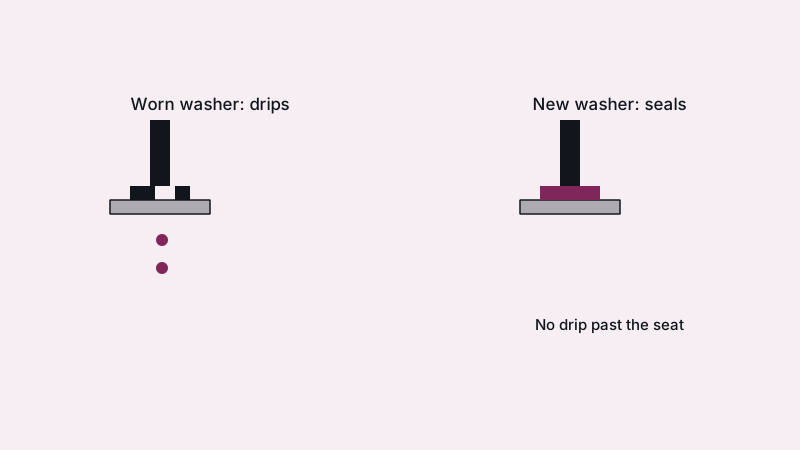
Buy a stem that matches the faucet's brand and length, and carry the old stem along as a sample. Smear a little silicone grease on the new seals, then reassemble in reverse.
Why is water leaking from the top of the spout, or from a cap on it?
You probably have a vacuum breaker, a small backflow device screwed on the spout. It prevents hose water from being siphoned back into drinking water, which is why plumbing codes call for one on hose connections. Water spitting from its cap or vent is normal for a moment after shutoff, but a steady leak means it is worn.
If it sprays whenever the faucet runs, unscrew it and replace it with the same thread size. Do not discard it and leave the spout bare. Backflow is a real contamination risk, discussed for irrigation and commercial systems in the backflow testing guide. A hose left attached can hold pressure against the breaker and make it weep, so disconnect hoses after use.
What if the water is escaping inside the wall?
Shut the water to the house if it keeps running. A stain on drywall near the faucet, a damp crawl space, or water flowing with the spigot closed says the pipe or stem has failed inside the wall. Fixing that means opening the wall or the pipe, which is work for a plumber.
Inspect the interior face of the same wall. How hidden water damage looks is shown in signs of a ceiling leak, and leaking water pipe repair covers the broader pipe problem.
When is a whole new spigot the smarter move?
Go for a new unit when the body has cracked, the threads are gone, the handle is seized, or repairs keep failing. A new hose bib means cutting or unscrewing the old one from the pipe, using solder, push-fit connectors or PEX fittings depending on what feeds it. Copper in Mission Viejo's older tracts can be brittle where it meets the wall.
Prices for hiring it out are in the faucet replacement cost guide. A bib swap stays well under the $1,000 mark that brings in California's contractor license rule, so it is a fair owner job, but work that opens walls or reroutes the main belongs with a professional.
Does a small outdoor drip really cost anything?
It does, because nobody watches it. EPA's yardstick for a typical household leak is over 9,300 gallons yearly, and a single drip each second tallies above 3,000. Spigots sit out of sight, so look at yours once a month, especially after a windy week.
A meter test finds hidden leaks: turn off every tap, note the meter, give it two hours, note it again. A dial that moved points to a leak somewhere, perhaps this one. If the bill looks high, read how a dripping faucet can lift a water bill.
What about an outdoor shower or rinse-off valve?
The logic carries over. An outdoor shower valve has a stem, packing and seat like a hose bib, so the repair follows suit: tighten the packing, replace the stem or cartridge, then check the fixture and the pipe behind it. The wrinkle: it may mix hot and cold, so the cartridge has to be the right one for the brand. Photograph the valve before you shop for parts.
Common questions
Why does the drip start only with a hose on?
A hose keeps pressure on the spout and loads the vacuum breaker or washer. Unscrew the hose and test again. If the drip stops, the hose end or its rubber washer is to blame. Replace the hose washer first, and think about taking hoses off after use.
Is a frost-free bib something I can repair?
Usually, given the correct stem. Close the water, unscrew the packing nut, draw the long stem out, replace the washer or cartridge at its tip and put it back. A stem that will not budge, or a pipe leaking inside the wall, means it is time to step back and call a plumber.
Do I need to winterize an outdoor faucet in Mission Viejo?
Hard freezes are uncommon here, so most owners skip an annual drain-down. Take hoses off and wrap bare pipe whenever a rare cold snap is forecast, and drain the system on any unheated cabin in the mountains. Frost-free bibs offer extra protection when a hose is left on.
How tight should the packing nut be?
Just enough to stop the weep, often a quarter to half a turn, with the handle still moving freely. If it stiffens before the leak stops, the packing or stem is worn out. Forcing the nut further can strip it or crush the packing.
Can a hose stay attached all summer?
For a short job, yes. Left for weeks, no. A connected hose keeps the line pressurized and can make the vacuum breaker leak, and a full hose can freeze in a cold snap. Many owners coil it after watering. A cracked bib behind a full hose may announce itself as a stained wall.
This guide is one of many on the plumber guide for Mission Viejo.
Sources
Updated