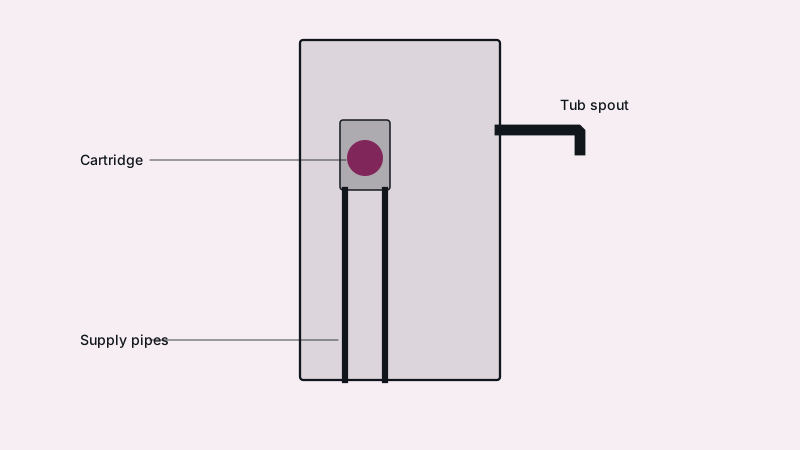
Start from the wet spot. If the spout drips while everything is off, suspect the washer or cartridge. If the handle base is damp, suspect the O-ring or packing. If the spout keeps running while you shower, suspect the diverter seal. Each has its own fix below. The wider set of kitchen, sink and bath fixture jobs is on the faucet, sink and disposal page.
What style of tub valve do I have?
First, how many handles are there? Two handles that spin through several turns hide rubber washers. One handle that pushes and pulls hides a cartridge. One that rolls over a ball and socket is a ball valve. A lever with silky, silent travel usually carries a ceramic disk cartridge. Underneath the trim lies the proof.
To see it, pry off the small cap on the handle, back out the screw behind it, and slip the handle free. Photograph the exposed parts, then keep the old piece to match at the store. Buying a near-miss cartridge is the commonest way this job goes wrong, so matching by sight beats matching by memory.
Bathrooms in Mission Viejo tract houses from the 1970s to the 1990s tend to have either a one-handle cartridge valve or an older two-handle set. Replacement parts for both are easy to find.
Where does the water get shut off first?
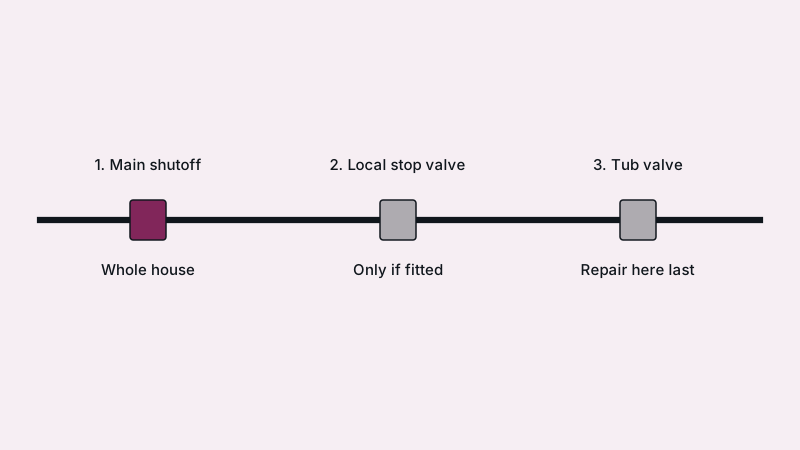
First look for a panel in the wall behind the tub, sometimes opening from a closet next door, where stop valves occasionally hide. With none, close the main water valve, often by the meter, then open a tap elsewhere to bleed pressure. Stuff a rag in the tub drain and lay a towel down so screws do not disappear.
Lay each part out on a towel in the order it comes off. Take a photo at every stage. A screwdriver and adjustable wrench cover most of the work, with a cartridge puller for stubborn ones. Never lever a frozen handle with a pry bar, because tile or the surround can crack.
If water still flows once the main is shut, the main itself is failing. Stop there and phone someone, because a faucet job that becomes a flood costs more than any visit.
What stops the drip on an older two-handle set?
Remove the handle, back off the packing nut and withdraw the stem. At its tip sits a rubber washer on a brass screw, usually flattened or split. Fit an identical one, look into the valve for a pitted seat, and rebuild. A scarred seat can be ground flat with a dressing tool, or the stem assembly can be swapped out.
Water around the handle itself calls for a fresh O-ring or packing, lightly greased. Open the water slowly afterward and test hot and cold. When one side of a pair has worn out, replace both washers, since the partner has served the same years and will follow soon.
How do I fix a single-handle tub faucet that leaks?
Remove the handle and trim plate, then the clip or nut that holds the cartridge in. Draw the cartridge straight out with pliers or a puller and note how it was oriented; many are keyed for hot and cold. Slide in the new cartridge in the same orientation, clip it, and rebuild. A drip that survives a new cartridge points to a worn valve body.
Cartridge swaps usually finish faster than washer jobs, and parts are sold by brand and model. Orientation errors reverse hot and cold, so test by feel after you finish. Mineral jamming, not wear, sometimes explains a cartridge that drips while shut, and hard water makes that likelier.
Is a leaking Moen repaired differently?
Moen single-handle faucets run on a replaceable cartridge, and a swap is the standard repair. Pull the handle cap and screw, lift off the handle, remove the retaining clip, and draw the cartridge with a Moen-style puller. Match the new part by shape and spline count, set it aligned, refit the clip, and test.
Cartridges differ between Moen lines, so identify yours through the maker's parts finder or the markings on the old one. If the drip continues with a fresh cartridge, corrosion in the valve body is likely and the faucet needs replacing. Shower valves share many parts and steps with these; visit fixing a leaky shower faucet.
Why is the tub spout running during a shower?
The diverter is the knob or lever that lifts water to the shower head. When its seal fails, some water slips past and keeps pouring from the spout. Where the diverter is a pull-up on the spout, replacing the spout takes minutes: free it by hand or at a set screw, then thread on a matching one.
A mere trickle often means the diverter gasket is worn or crusted with scale, and a vinegar soak can revive it. A diverter built into the wall valve rather than the spout is plumber work. Scale is a regular culprit around here; hard water is common in south Orange County, your water district's quality report lists the number, and removing hard water scale has safe cleaning steps.
What about water dripping from the pipes under my kitchen sink?
Park a bucket below, close both angle stops, dry the pipes and run a paper towel along each joint to find the true wet spot. Usual offenders: a slack slip nut on the drain, or a supply fitting. Snug it a quarter turn by hand, or replace the washer or braided line. Plastic nuts crack when overtightened.
A cracked or corroded pipe needs replacing, and tape is not a repair. Deeper coverage lives here: fixing a leaking pipe under the sink, a leaky sink faucet and the basic dripping faucet guide. If water runs steadily, shut the main.
Common questions
What is the repair bill for a dripping tub faucet?
Swapping a cartridge or washer is typically a brief visit made of a trip charge, parts and labor, while a whole new faucet costs more. Ranges appear on the faucet replacement cost page plus installing a faucet, and a written figure should come first.
Does a slow drip really matter for my water use?
It adds up. Drips accumulate between bills, and the EPA reckons the typical house leaks away more than 9,300 gallons in a year, so small drips are worth fixing. To size up your own drip, see do drips raise the water bill.
Can the repair happen without closing the main?
Only if the tub has working stop valves, which most lack. Otherwise the house main has to close for the job. A main that refuses to close, or leaks past its stem, is the signal to call a plumber rather than push on.
My shower head drips too. Is it the same fix?
Usually, because one valve often feeds both, so a new cartridge or washer cures tub and shower together. A shower head that dribbles after use means the valve is passing a little water. A leak inside the wall is a different matter, handled on the shower leak page.
Should I replace the faucet rather than repair it?
When the valve body is corroded, parts are no longer made, repairs fail within months, or you simply want a new style. A cartridge is cheaper for a sound valve. Some tub replacements need the wall opened, which is plumber work, and the plumber confirms any permit with the city.
For the wider picture, start with plumber across Mission Viejo.
Sources
Updated