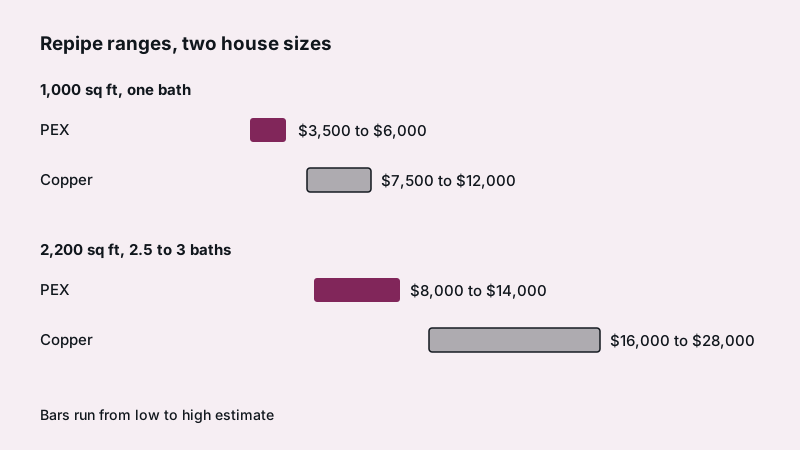
A published contractor guide puts a whole-house repipe at $3,500 to $14,000 in PEX and $7,500 to $28,000 in copper for houses from 1,000 to about 2,200 square feet. That guide is not a Mission Viejo invoice. Only a written quote, after someone counts your fixtures and sees your walls, gives the true figure. The sections that follow break that spread apart, which lets you test any bid you receive. The repiping overview explains the job itself.
How much more does a bigger house cost to repipe?
One published contractor guide shows about $3,500 to $6,000 in PEX for a small home of 1,000 square feet with one bath, and $8,000 to $14,000 in PEX for about 2,200 square feet with two and a half to three baths. Copper roughly doubles those numbers: $7,500 to $12,000 for the small home and $16,000 to $28,000 for the larger one.
| Home | PEX | Copper |
|---|---|---|
| Roughly 1,000 sq ft with a single bath | $3,500 to $6,000 | $7,500 to $12,000 |
| Roughly 2,200 sq ft with 2.5 to 3 baths | $8,000 to $14,000 | $16,000 to $28,000 |
Those rows come from one published guide, not an offer. The same guide lists a 1,500 square foot house with two baths at $5,500 to $11,000 in PEX and $12,000 to $22,000 in copper.
Is price per square foot or per fixture the better yardstick?
Fixture count tells you more, although the published guide quotes square feet: $3.50 to $7.00 for PEX and $8.00 to $14.00 for copper. No sourced per-fixture figure turned up, so none is printed. Pipe length follows the number of fixtures and where they sit, not floor area.
Picture two houses. One has 1,200 square feet and three bathrooms. The other has 2,000 square feet and a single bath. The first needs more branch lines. So count each toilet, sink, tub, shower, dishwasher, washer box, ice maker and hose bib, and expect the quote to list them by name.
How can I build a rough number before a visit?
Start with the guide's size table, then adjust for your own house. Count every toilet, sink, tub, shower and hose bib, compare that with the closest row, and treat the result as a band, never a price. A visit to the house replaces the band with a real figure.
- Count fixtures and note the square footage and the number of baths.
- Find the closest row in the table above.
- Add patching if the quote leaves it out. No sourced patching figure is printed here, so ask each bidder to price it on its own line.
- Add the permit and inspection, which the written quote should name.
Compare the band with the table above. Where a bid lands far outside it, ask which line explains the gap.
PEX or copper: which one makes the bill smaller?
PEX, and the published guide says it saves between 40 and 60 percent against copper. Labor is a large share of any repipe, and flexible tubing snakes through framing with fewer joints, so crews finish sooner. Read the full comparison in PEX vs copper, and the pricing of the cheaper path in PEX repipe cost.
South Orange County water is imported and hard. Some owners trust copper's long record in it. Others choose PEX precisely because it does not pinhole. Neither answer is wrong. What matters is that the written bid names the tubing, its rating and the fitting style.
Where can I trim the bill safely?
Choose PEX, repipe only the failing branch if the rest tests sound, and schedule patching in the same visit. Ask each bidder to price the patching and paint on its own line, since that is where bids differ most. A bid that is cheapest on paper can be the costliest if it omits the permit, the patch or a pressure test.
Cost levers that are safe to pull:
- Ask the plumber to open walls where patching is cheap, such as garages, closets and attic runs.
- Take over the painting after the patch.
- Pair the work with a remodel so walls open only once, which is the situation described under bathroom remodel plumbing.
- Collect three bids built on one shared scope, otherwise the totals cannot be compared.
What pushes the price up in an older Mission Viejo house?
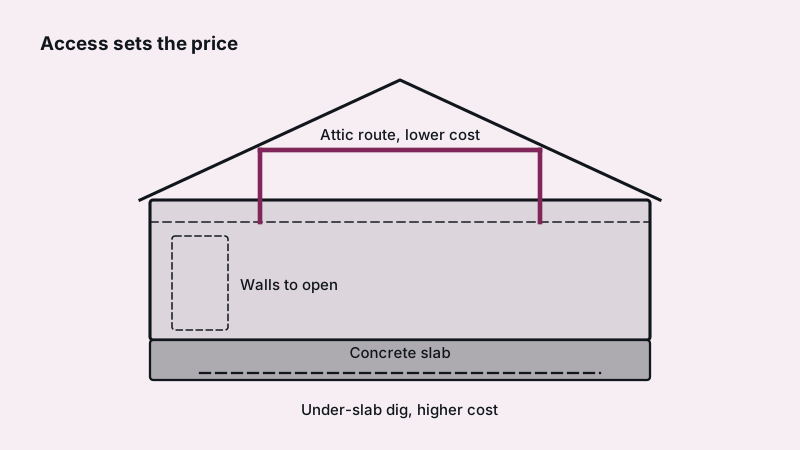
Access and age. Tract homes from the 1970s into the 1990s may contain copper that has begun pinholing, or polybutylene, which was widely installed from about 1978 into the mid-1990s and is known for failing. Two stories, slab floors and cramped attics all take longer, and damage found inside the walls can add a line.
Points worth raising with any bidder:
- What is in the walls now. Poly, galvanized and old copper each need their own plan. See polybutylene replacement and galvanized pipe replacement.
- Water pressure. Hillside streets can run high, so the regulator deserves a look while pipes are open.
- Overhead or under-slab routing. Attic routes cost less than cutting concrete.
- HOA rules. Some associations restrict hours or require notice.
- The permit. The Mission Viejo Building Division issues it and inspects the work. Ask who files.
If the house is truly old, the cost of redoing an older home's plumbing goes further, and the reasons to repipe cover the signs.
What does a manufactured home repipe cost?
It follows a different pattern, so ask for a quote instead of trusting a rule of thumb. Runs are shorter, but they sit in the floor cavity or belly wrap, so access and insulation replace drywall as the main expense. I found no published California figure worth trusting, so none appears here.
How do I pay for a repipe without getting burned?
State law keeps the deposit small: either 10 percent of the contract or $1,000, whichever is the lesser amount. Verify the contractor's state license, put scope and price on paper, and release money as stages are completed. Be wary of anyone who wants cash before starting.
A contractor must carry a California license once the total passes $1,000. For the bigger picture of rates, what plumbers charge is a good companion.
Common questions
Is a repipe worth paying for?
When leaks, brown water or weak flow keep returning, yes. It ends the cycle of patches and wall damage. If only one branch is bad, a partial job may be enough. Ask the plumber to judge the remaining pipe and to pressure test whatever stays.
How long do pipes last before they need replacing?
It depends on material and water. Old galvanized steel and polybutylene are what push most older homes to act. Copper often lasts decades, though pinholes can show up early in aggressive water. PEX has the shortest track record. A history of leaks outweighs the calendar.
Does the city need to approve a repipe?
In California a repipe is normally permitted and inspected by the city building department, and in Mission Viejo that is the Building Division. Ask each bidder if the permit fee and inspection visit are priced in, and who takes the paperwork to the city.
Can an online calculator give me the price?
Only a loose one. Calculators work from size and pipe type, so they cannot see your walls, your slab or the condition of the pipe. Use the worksheet on this page to set a band, then hold a written quote up against it and ask about any gap.
How long is the house without water?
A typical house needs a few days of plumbing, with water shut off for a part of every day. Patching and paint often stretch the project into the following week. Two-story and slab homes run longer. Have the plumber list each shutoff window in writing.
Budget sorted? the plumber guide for Mission Viejo explains the rest of the job.
Sources
Updated