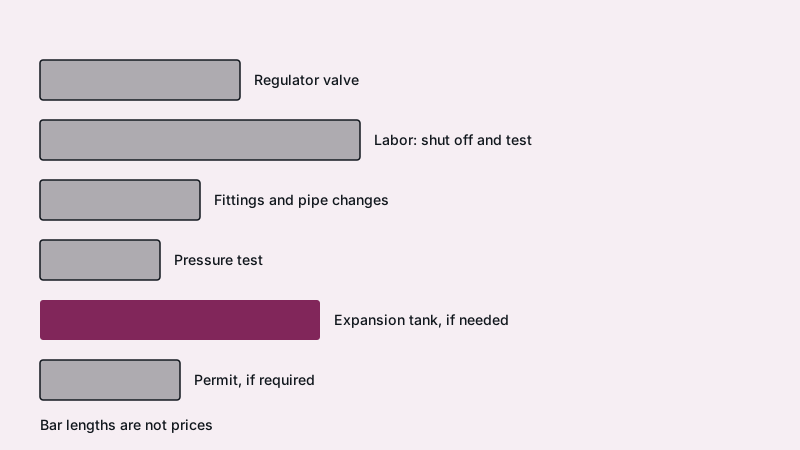
The valve itself is the smaller part of the bill. Price moves with swap versus first install, how reachable the old valve is, whether the line is three-quarter or one inch, and whether a thermal-expansion tank or permit joins the job. We do not print a figure we cannot source, so the figure that counts is the one the plumber writes down, and below is what belongs on it. The symptom itself is covered under low water pressure.
What am I paying for on the invoice?
Three things: the valve, the labor to cut in and test it, and whatever the house demands around it. Published price guides run wide, and that spread is the lesson. Trading an old valve in a roomy garage is small work; opening a finished wall or digging a trench to add one is not. Every quote should break these out.
Lines worth asking for, so two quotes can be set side by side:
- The regulator itself (brand, size, adjustable or preset).
- Labor for removal and installation, including shutting off and restoring water.
- Fittings, unions and any pipe changes.
- Pressure testing before and after.
- An expansion tank, if one is needed.
- Permit and inspection, if your city requires them.
Why is my regulator job priced differently from a neighbor's?
Because the houses differ. Mission Viejo has planned communities from the 1960s through the 1990s, so one street may have a regulator tucked beside the main in the garage while the next has it buried under a front planter. Pipe size (three-quarter inch or one inch), pipe material, and how far the valve sits from a shutoff all change the time.
Hillside tracts see higher street pressure, which is why a regulator matters more there. A house with a single regulator that has failed is simpler than one with no regulator and a main that needs cutting open in a tight space. Have the plumber say which of these describes your house before quoting.
Is replacing a worn-out regulator the cheaper case?
Usually. The old valve leaves and the new one takes its place. Symptoms of a dying regulator include pressure that rises and stays up, readings that swing, banging pipes, a weeping relief valve at the heater, and faucets that start dripping. A cheap hose-bib gauge confirms it.
Cost rises if the old valve has corroded into its fittings, if nearby pipe needs mending, or if the new body is a different length and the pipe must be re-cut. Before paying for a swap, read about adjusting the regulator, since a few drift cases are cured by the setting, and about regulator replacement from start to finish.
Might the visit add an expansion tank?
Quite possibly. A regulator with a built-in check valve, like a backflow device, turns the house into a closed loop where heated water has no place to expand. Mission Viejo's handout calls for an expansion tank at the heater in a closed system. Should yours lack one, it can be added, at extra parts and labor.
Check for a small round or cylindrical tank on the cold pipe by the heater. A relief valve that keeps dripping can hint that the tank is missing or used up. The water heater expansion tank page covers the replacement.
Does this job need a license or a permit?
California's contractor-license rule begins at $1,000 for parts plus labor, so a plain regulator swap might land beneath it; permits are a different, city-level question. Ask Mission Viejo Building Services, 949-470-3054, whether your address needs one. Adding a regulator to the main means cutting the drinking-water line, so it is not a beginner's weekend project.
Past $1,000, look the contractor's number up with the state board. Deposits on such contracts cannot exceed one tenth of the price, with $1,000 as the ceiling.
How do I tell whether I need a regulator at all?
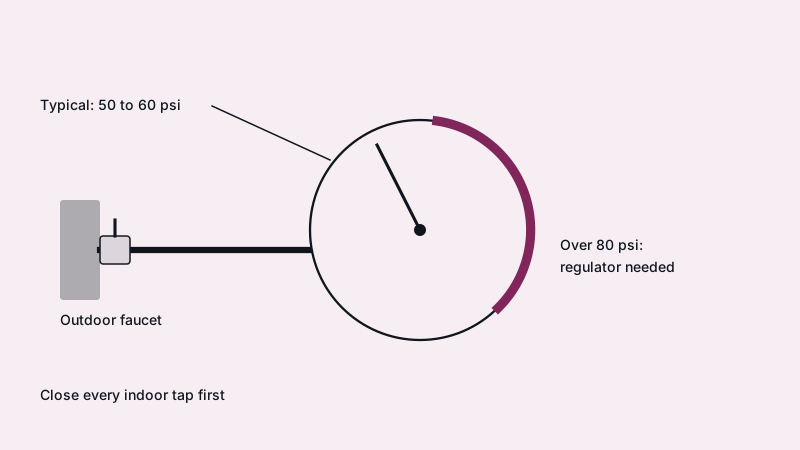
Measure before you spend. Screw a gauge onto the hose bib outside, confirm nothing indoors is using water, then read it. Codes generally look for a regulator when static pressure climbs past 80 psi, while plenty of homes sit happily around 50 to 60. A much higher reading, especially late at night, suggests a regulator that is absent or failing.
Low pressure is a separate problem with different causes, such as a closed valve, scaled pipes or a partly shut meter. For the weak-flow side, see why water pressure drops, and to find the valve, where a regulator is located.
What keeps the final bill predictable?
Bring a gauge reading, keep the way to the valve clear, and insist the quote names the model and size. Compare two quotes line by line rather than by the bottom figure. In your price request, say what you measured and whether banging pipes or dripping started lately.
Common questions
What if the pressure problem is not the regulator?
Then the fix, and the bill, change. A half-shut valve is far cheaper than a dead regulator, and a regulator is cheaper than scaled-up pipe. That is why diagnosis comes first. The quote should state what was found and show time and parts separately.
When does a regulator wear out?
No fixed age applies. Talk of a decade or more is common, though hard water, pressure swings and grit cut that short. If pressure creeps up after years of calm, or fixtures start dripping, test it. A failing regulator sometimes gives warning through water hammer, covered on the water hammer page.
Can an owner adjust one?
Many have a screw and locknut, and a small drift is often corrected with a turn or two while a gauge is attached. One that keeps drifting off its setting has had it. Never adjust blind: the dial tells the truth.
Is a visit fee added?
Some plumbers charge a trip fee and credit it against the work, and others waive it; ask at booking. How such fees are commonly set up is explained at service call costs, with hourly pricing in the general plumber cost page.
Prices are one part of the job: plumber mission viejo covers the rest.
Sources
Updated