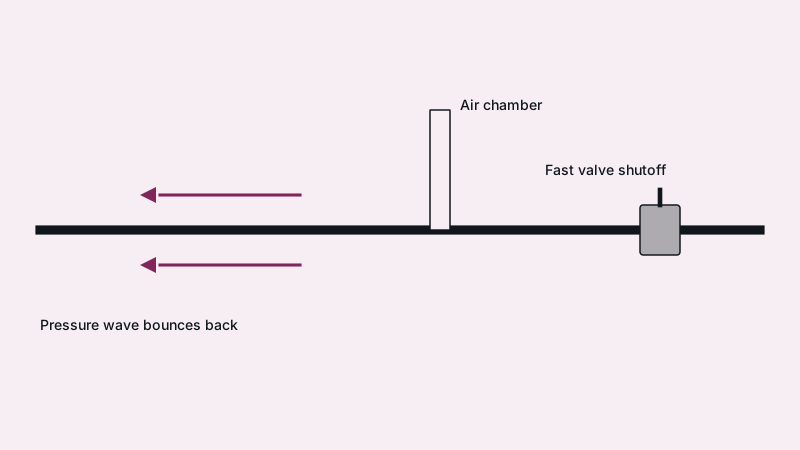
The sound you are hearing is moving water that has just been stopped. Water moving through a pipe carries weight and speed, and a valve that snaps closed leaves all of it with nowhere to go, so it slaps the pipe as a pressure wave. You hear it as a bang, a repeated knock, or a shudder. It is complete proof that something in the system, usually pressure or a quick-closing valve, is stressing your plumbing. For help, see the plumber service page or send a quote request, while the home page shows our other services.
What exactly is a water hammer sound?
It is the noise of a pressure surge. Wikipedia explains that a surge happens when moving fluid is stopped or redirected suddenly, and that the effect can range from noise and vibration to a ruptured pipe. In a house the trigger is nearly always an appliance valve that shuts fast.
You may hear a single loud bang, a series of knocks as the wave bounces back and forth, or a shaking in the wall. The sound often seems to come from far from the fixture, because the shock travels along the whole run of pipe.
Which things in my house set it off?
Dishwashers, washing machines and toilets that cut the water off abruptly are the classic triggers, according to Wikipedia. Single-lever faucets closed in a snap do it too. A pump stopping or a check valve slamming can have the same effect, and so can refilling an empty pipe that has a partly closed valve in it.
To find your culprit, run each fixture one at a time and shut it off while listening. The one that bangs is the source. A knock only as the washer finishes filling points at the machine's own valve. A knock at every tap points to pressure or pipe support.
Could pressure from the street be driving the noise?
It is a prime suspect, and in a hilly city it is worth testing. Mission Viejo was laid out with homes on hills and roads in the valleys, per Wikipedia, so pressure differs from street to street. Higher pressure means a faster-moving column of water and a bigger surge when it stops.
Attach a gauge to the front or back hose bib, with every indoor tap idle. A reading above 80 psi calls for a regulator under California Plumbing Code section 608.2. Wikipedia lists a regulator on the building supply as a remedy for surges. The steps for adjusting a pressure regulator are in our guide, and finding the regulator shows where it hides.
Can I quiet it with a free fix?
Sometimes. Start with the pipes themselves. A loose pipe will clatter against framing, so check exposed runs in the garage or under the house and see whether straps are missing. Then check the pressure. If the main valve is not fully open, the flow can chatter, so open it all the way.
Next, check whether an air chamber has filled with water. Some older homes have short vertical stubs behind fixtures, which hold air as a cushion. When they waterlog, the cushion is gone. Shut the main, let the highest and lowest taps run until they sputter dry, close both, then reopen the main slowly. The air refills the stubs. If the bang returns in a few weeks, they are waterlogged again and need a different fix.
What are the permanent fixes, from cheapest to most involved?
Four, in rising order of cost: strap loose pipe, add a water hammer arrestor at the offending appliance, add or adjust a pressure regulator, and replace a failing valve. An arrestor is a sealed canister that works like a car's shock absorber, fitted between the supply pipe and the appliance. Wikipedia describes it as hydropneumatic.
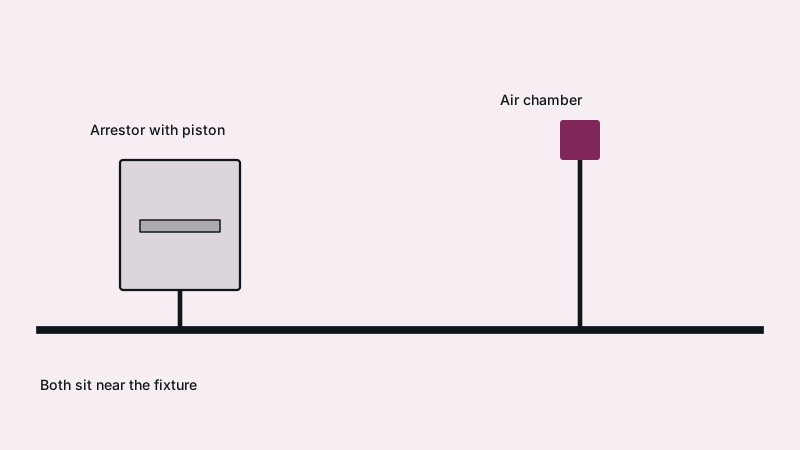
The bigger step is covered under replacing a pressure regulator. Wikipedia also lists slow-closing valves, quiet-fill valves, non-slam check valves and shorter branch runs. A plumber can match one of these to what you hear, and the price depends on access.
Could the hammer come from the water heater instead?
Yes, and it needs a separate check. A water heater makes its own sounds: ticking from expansion, rumbling from scale, and a thump at the relief valve if pressure spikes. If a regulator or check valve near the meter seals the system, swelling water is trapped, and each heating cycle spikes pressure unless an expansion tank soaks it up.
If you hear a bump or the relief valve drips, look at the expansion tank replacement page. Hard water can also build scale in a tank, which makes a different, rumbling sound.
When is this a job for a plumber?
Call when the banging is loud, when it came on suddenly after work on the plumbing, when you also see leaks, or when pressure reads high and you are unsure about adjusting the regulator. Repeated hard shocks can loosen fittings and stress joints over time.
A plumber can test the pressure, locate the loose or waterlogged parts, and install arrestors. Work that involves the main line or soldering is not a homeowner task. Check what permit rules apply with Mission Viejo Building Services at 949-470-3054 before major changes, and remember that a state contractor license is required from $1,000 of work.
Common questions
What makes a pipe bang the instant a tap closes?
Because the stopped water's momentum has to go somewhere. A fast-closing valve halts the column suddenly and the shock wave hits the pipe. Higher pressure, loose straps and missing air cushions make it louder. Slowing the valve or absorbing the shock with an arrestor usually fixes it.
Is hammering harmful to the plumbing?
Yes, over time. Wikipedia says a surge can range from noise to pipe rupture. Most house hammer is a nuisance that wears fittings, valves and appliance hoses slowly, but repeated hard shocks can open a joint. Treat a loud bang as a reason to check pressure, not as a sound to ignore.
Does a water hammer arrestor really work?
When sized and placed correctly, yes. It works like a shock absorber, with an air or gas cushion that takes the surge. Place it close to the quick-closing valve, such as at the washing machine supply. It will not cure a pressure problem, so fix high pressure first if the gauge shows it.
Is it the same as a knocking sound when the water is running?
Not usually. Knocking or ticking while water flows or the water heater heats is often thermal expansion in loose pipe, not a pressure wave. Hammer shows up at the moment a valve closes. If you are unsure, note when the sound happens and describe it to the plumber.
Sources
Updated