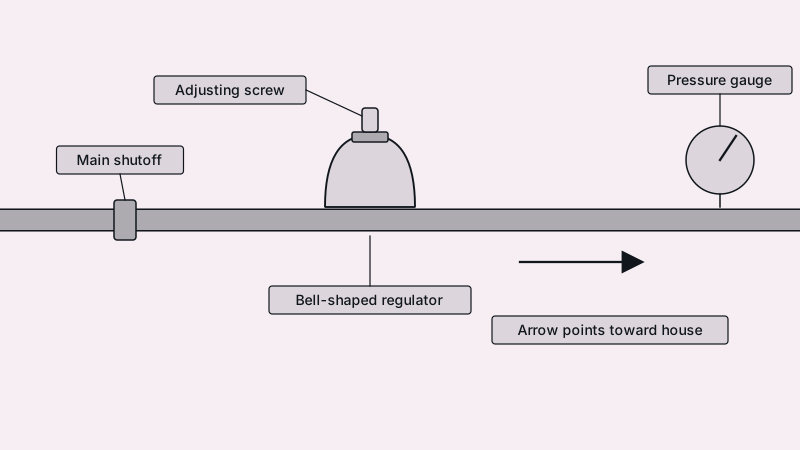
Every adjustment starts with a number, not a wrench. Fit a gauge to the spigot outside, shut every fixture in the house, and read the dial. Most plumbing codes treat 80 psi as the ceiling, and many manufacturers set their valves near 50 to 60. If yours reads outside that band, a quarter turn of the adjusting screw usually fixes it. This is one of several causes of low water pressure, and it is also the cause when pressure is too high. Need help? Use the quote request.
How does the bell-shaped valve hold pressure steady?
A regulator is a spring-loaded valve with a diaphragm inside the bell. Street pressure pushes on one side and the spring on the other, so the valve opens just enough to hold house pressure at the spring's setting. It limits inflow, and, as Wikipedia notes for regulating valves generally, it protects appliances and pipes where line pressure runs too high.
It is not a check valve. Water can still flow backward through it, which matters later for thermal expansion.
How do I test the pressure before touching the valve?
Screw a hose-thread pressure gauge, sold for about the price of a lunch at any hardware store, onto an outdoor faucet. Turn off every tap and appliance first, including the ice maker and irrigation. The needle then shows static pressure. Read it at a quiet hour, since neighbors using water can drag the number down.
Then open a tub faucet. If the needle drops by more than 10 to 15 psi, the regulator or the pipes are restricting flow, which is a different job from simply turning the screw.
What is the actual adjustment procedure?
Find the valve and back off the locknut crowning the adjusting screw by about a turn. Clockwise on the screw raises pressure; counterclockwise lowers it. Make quarter-turn changes, open a faucet briefly to let the setting stabilize, and recheck the gauge. Retighten the locknut when the dial sits where you want it.
Aim for the middle of the range, about 55 to 60 psi in a typical home, unless an appliance manual asks for something else. A bolt-head screw needs a wrench, while some valves use a slotted screw.
Which corner of the property hides the regulator?
Trace the main supply line from the shutoff valve, close to where the pipe rises out of the slab or wall. Common spots are the garage wall, the front of the house by the hose bib, and a buried box near the curb. If you cannot find a bell-shaped brass valve, you may have none, which in a hilly neighborhood is worth confirming.
Each hiding place gets its own walkthrough in finding the regulator.
Why do Mission Viejo hills make pressure a bigger deal?
Pressure at a house depends partly on how far it sits below the water district's reservoir. Mission Viejo was laid out with homes on the hills and roads in the valleys, according to Wikipedia, so two houses a mile apart can see very different pressure. Lower lots often receive more.
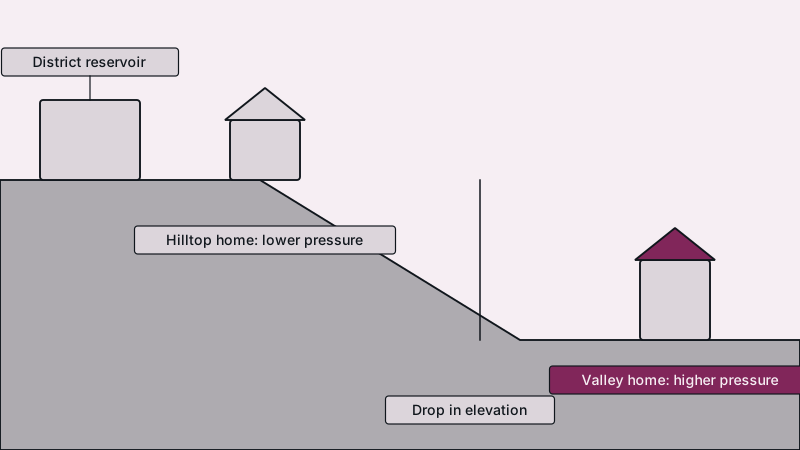
Excess pressure wears out toilet fill valves, washer hoses and water heaters early, and it makes pipes knock. If you hear that, see the water hammer sound page. Your water bill shows which district serves your address, so ask the one on your bill what pressure zone you are in.
How can I tell the valve is finished?
Swap it if it refuses to hold a setting, when pressure climbs overnight with no use (creep), when water hisses at the valve, or when it is leaking. Many regulators last years, but the diaphragm and seat wear, and grit can foul the seat. If the adjusting screw spins with no change on the gauge, the valve is finished.
When the new valve matches the old body and unions, a plumber is usually done in an hour or two. The full job is described in regulator replacement, and the dollar side is in regulator installation cost.
Is swapping the valve a weekend job?
It can be, when the valve sits between threaded unions and the main shuts off cleanly. Anything involving a torch or a cut into the main line should go to a plumber. A small swap stays below the $1,000 point at which a state contractor license becomes mandatory, yet it is still worth asking Mission Viejo Building Services whether a permit applies.
Steps for a direct swap:
- Shut the main, then open one faucet to bleed the line.
- Unscrew the old valve at its unions, noting the flow arrow.
- Fit the new valve with the arrow pointing downstream, using pipe thread sealant.
- Open the main slowly, check for drips, then set pressure with the gauge.
Does a new regulator mean a new expansion tank?
Often. Once a regulator seals the house off from the street, the water that swells inside a heating tank has no exit, and each burner cycle spikes pressure. A compact expansion tank teed into the cold line soaks that up. Check the tank's air charge matches the house pressure you just set, or it will not work.
If a water heater relief valve drips after you adjust the regulator, that is the usual sign the tank is missing or waterlogged. See the expansion tank replacement page.
Common questions
What does replacing the valve involve?
Shut the main, drain pressure at a faucet, unscrew the old valve at its unions, and fit the new one with the flow arrow facing the house. Open the main slowly, check for leaks, and set the pressure with a gauge. If the valve is soldered in, or the main is old and corroded, call a plumber.
What exactly is this valve?
A brass bell fitted to the incoming line, which keeps house pressure level whatever the street is doing. Inside, a diaphragm and a spring balance the incoming water, and an adjusting screw changes the spring's tension. It protects fixtures and appliances from high pressure but does not stop backflow.
What psi belongs in a pressure tank?
Pressure tanks serve private wells, not the city water Mission Viejo homes use. A well tank's air charge usually sits roughly 2 psi under the pump's cut-in setting, so a 40/60 switch pairs with a 38 psi charge. Check the air with the pump off and the tank drained. A regulator does not apply here.
Can a homeowner fit one unaided?
Yes, if the valve is threaded and union-fitted and the main shutoff works. Soldered joints or a corroded main should go to a plumber. Check the city's permit rules first, and confirm the result with a gauge afterward, since a valve that is installed but never set can leave pressure unchanged.
The rest of our guides start from the plumber guide for Mission Viejo.
Sources
- Wikipedia, Pressure regulator
- Wikipedia, Water hammer
- Wikipedia, Mission Viejo, California
- Manufacturer installation sheets for residential water pressure reducing valves
- City of Mission Viejo, Building Services
Updated