Look for a squat brass bell on the pipe just inside the point where water reaches the house. That is the regulator, and it trims street pressure to a level your pipes, fixtures and heater can tolerate. Replace it once it stops holding its setting: a hose-bib reading that is too high or too low, a number that creeps up while the house sleeps, or a valve that leaks, hums or chatters. For a low-pressure complaint, the low water pressure page covers other causes, and the request form asks for a plumber.
How can I tell my regulator has failed?
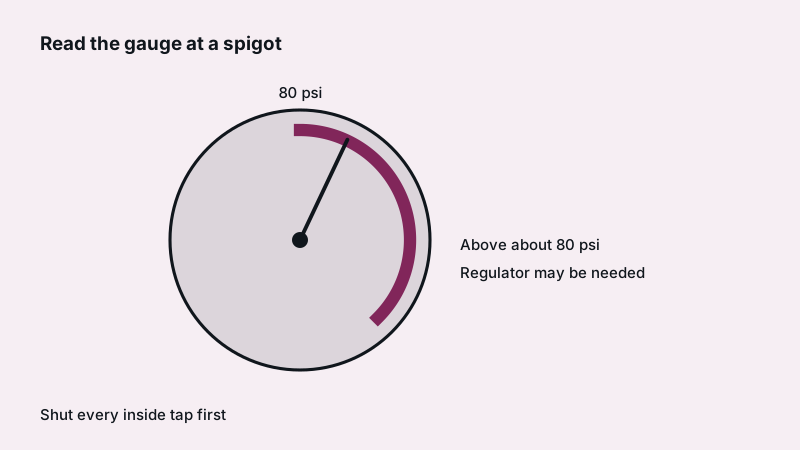
Measure the pressure. A pressure gauge that threads onto a hose spigot is a small purchase: attach it, shut off everything inside the house, and read the dial. A reading that is steady, in a moderate range, means the regulator is working. High or wandering numbers, or a reading that climbs overnight, mean it is failing. A gauge beats guessing.
Signs you may notice before you test:
- Faucets that spray hard, or hoses that whip when opened.
- Banging pipes when a valve shuts. See water hammer sounds.
- A relief valve on the heater that drips on and off, which can signal pressure spikes.
- Supply lines, washing-machine hoses or toilet fill valves failing early.
- No flow at all, or weak flow at every tap, when the regulator has clogged with debris.
The California Plumbing Code (section 608.2) calls for a regulator when static pressure tops 80 psi, and the City of Mission Viejo Building Division can say which edition applies. A plumber with a gauge will tell you where your number sits.
Should the regulator be adjusted, or replaced?
Adjusting works when the valve is sound but set wrong. If a turn of the adjusting screw changes the reading smoothly and it then holds, leave it. Replace the regulator when the screw does nothing, the reading drifts up after you set it, the valve leaks, or it is old. Adjustment is a stopgap on a worn valve.
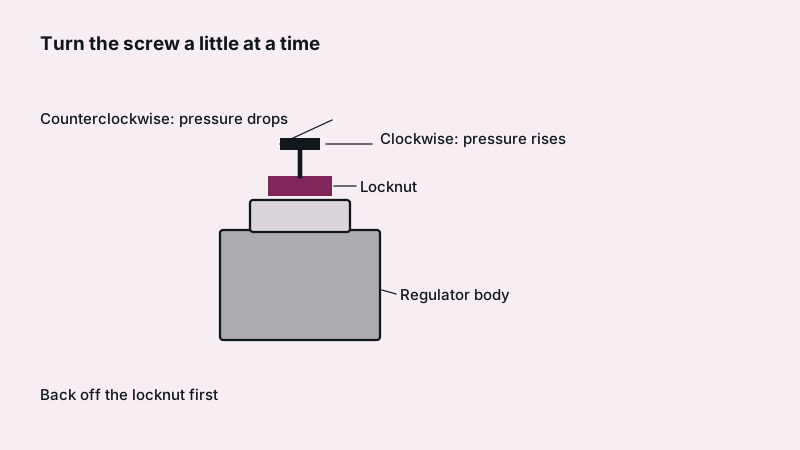
In outline: back off the locknut, nudge the screw a little at a time (clockwise raises, counterclockwise lowers), read the gauge each time, then lock the nut. Detailed steps are in adjusting a regulator valve, and finding the valve is covered in where the regulator sits.
Age matters. Makers publish service lives that vary; ask the plumber what the unit in your home is rated for, and plan a replacement before it fails in a way that damages your pipes. Regulators in homes built in the 1980s and 1990s may be the original unit.
Why does Mission Viejo see pressure problems?
Mission Viejo is hilly, and water is delivered in pressure zones, so a house lower down the hillside may see more at its meter than one up on a ridge. Districts balance pressure in bulk; what reaches your fixtures also depends on your elevation and zone, which is why regulators sit at individual houses.
No published pressure figure for any particular district was retrieved for this page, so we cannot give a number for your street. Use a gauge. Your water bill names your district, and the district can tell you the typical pressure in your zone.
Pressure that stays high wears out seals and hoses, turning small leaks into larger ones. Leaks add up: the EPA's yardstick for typical household loss runs into the thousands of gallons a year.
What does replacing a regulator involve?
The sequence: close the main, relieve the line, cut or unthread the old regulator, fit the new one with matching connections, and bring water back slowly. Then set the pressure against a gauge and check each fitting for seepage. A straight replacement can fit inside part of a day.
What can change the work:
- Matching connections. A new valve in the same size and style swaps in directly. A different style may need pipe changes.
- Access. A regulator in a garage wall is easy. One buried in a yard box or under a slab is harder.
- Corroded pipe. Aged pipe sometimes crumbles when cut, which adds a length of new pipe.
- Expansion control. A regulator can make the supply a closed system, so the heater needs somewhere for expanding water to go. Find out whether an expansion tank exists and works.
Permit rules vary, so ask the City of Mission Viejo Building Division whether a swap needs one and who files it.
Does a new regulator mean I need an expansion tank?
Possibly. A regulator, or a one-way valve at the meter, stops pressure from pushing back into the street while the water heater warms. Without an expansion tank or other relief, house pressure climbs each time the heater fires, which can open the relief valve or stress pipes. A plumber can tell whether your system has a working tank.
Read water heater expansion tank replacement for how a tank is checked and swapped. A tank that has failed has the same symptoms as a bad regulator, so both are checked at once.
What should a regulator quote include?
Fixr lists replacing a water pressure regulator, labor included, at $250 to $1,000. A complete quote names the regulator, labor, any pipe changes, an expansion tank if needed, and the permit, as laid out in regulator installation cost. Ask the plumber to set the final pressure and show you the reading.
California wants a contractor license once a job reaches $1,000 including parts. A regulator job often falls under that, but if more pipe gets involved, ask for the contractor's number.
Common questions
What is a comfortable pressure for household plumbing?
Figures of roughly 40 to 60 psi are often quoted as comfortable, and 80 psi is widely cited as the ceiling that triggers a regulator, and CPC 608.2 is the 80 psi source. A gauge reading plus the plumber's recommendation tells you what suits your fixtures and pipes.
How long does a pressure regulator last?
Make and water quality both play in. Many last a decade or longer, and a failing one often shows first as creeping pressure. We could not confirm a figure from any maker's documentation, so have the plumber note its age and condition at each visit.
Is replacing a regulator a weekend project?
Turning the adjusting screw is something an owner can do. Replacing the valve is different: the main supply gets cut, a permit may be needed and the new valve must be set carefully, so we recommend a plumber. A mistake at the main floods the house fast, and a wrongly set valve damages plumbing.
Can a bad regulator cause low pressure?
Yes. A stuck or clogged regulator can choke flow so every tap is weak, and grit or scale inside the valve is a common reason. Test with a gauge, and if a plumber is there, compare readings upstream and downstream of the regulator.
Where is the regulator in my house?
Look beside the main shut-off, commonly a front wall, the garage or the heater area; it resembles a brass bell. Some homes bury it in a yard box. A plumber can point it out if it eludes you, and can label it for next time.
For the wider picture, start with plumber mission viejo.
Sources
Updated