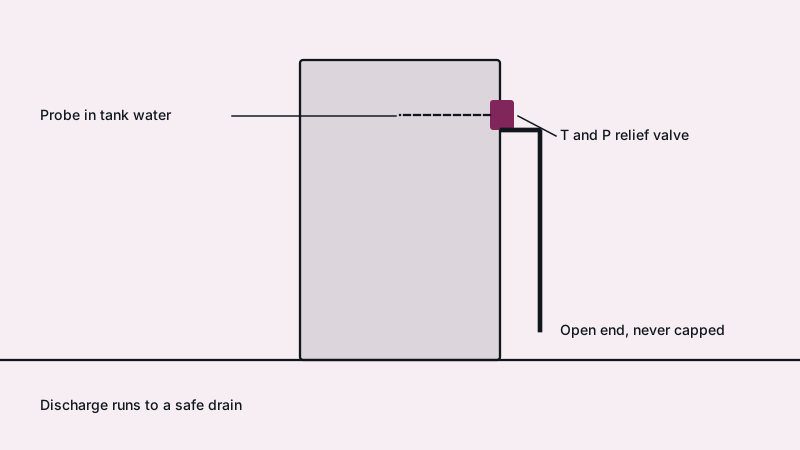
Replace the valve when it drips steadily, when it will not move after you lift its lever, or when it has been discharging and is now corroded or crusted. The part is a standard fitting and the swap is quick for a plumber. Before you buy one, though, find out why it opened, because a valve that keeps relieving pressure is reporting a problem somewhere else. Everything about tank units sits under water heater repair.
What does the relief valve protect against?
The brass valve on the side or top of the tank, called a T&P valve, pops open on its own when heat or pressure inside climbs too high, sending water down a discharge pipe before the tank gives way. A typical home valve is set to let go at 150 psi, or at 210 degrees F. Think of it as the last line of defense, never a part that should operate routinely.
A tank heater keeps hot water under pressure. Should a thermostat fail or a burner stay lit, temperature and pressure rise, and the valve is what stands between that and a ruptured tank. A heater without a working one puts the home at risk, so nobody should cap, plug or pull one out, even a dripping one.
How do you tell the valve itself has failed?
Look for a steady drip at the discharge pipe, mineral crust around the outlet, a lever that will not budge, rust at the threads, or an original valve a decade old that nobody has ever tested. A valve that drips only after the heater fires is usually reacting to pressure, not failing as a part.
A short checklist:
- Drip at the discharge pipe. Constant, or only during heating cycles?
- Crust or green and white deposits. A sign of repeated weeping.
- Stuck lever. A valve that cannot be lifted may not open when needed.
- Wetness at the tank threads. The leak may be at the fitting, not the valve.
Leave lever testing to the plumber if you can. The discharge is scalding, and an old valve may refuse to reseat afterward. If you do try it, aim the discharge pipe at a drain or bucket and keep hands and face well clear.
Why does a new valve keep dripping?
The usual causes are thermal expansion in a closed plumbing system, street pressure above what the valve tolerates, or a thermostat set too hot. Heating makes water expand, and when a check valve or regulator stops it from backing out, pressure peaks each cycle and the valve spits. A fresh valve alone will not cure that.
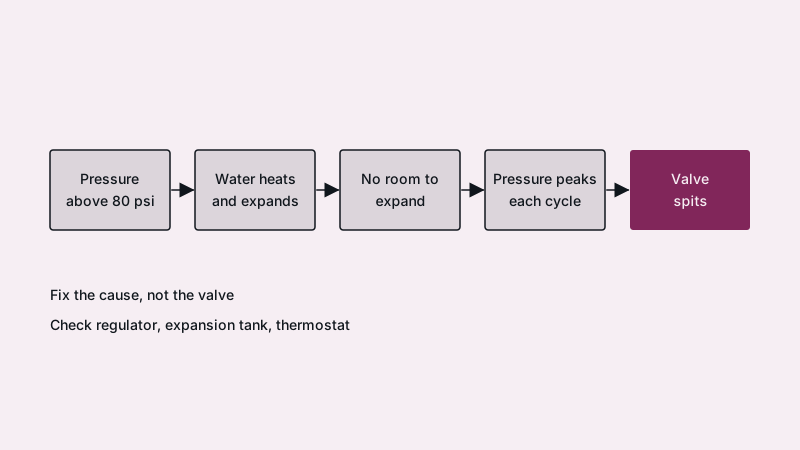
Fixes sit outside the heater:
- Gauge the static pressure at a hose bib; code in this state expects a regulator once the reading exceeds 80 psi.
- Inspect the expansion tank, which absorbs the extra volume; a waterlogged one has stopped protecting the system. The expansion tank replacement page explains the swap.
- Look at the regulator, if one is installed. See replacing a failed regulator.
- Check the thermostat setting. Water hotter than intended raises both temperature and pressure.
Higher street pressure is common on hillside tracts, which makes this chain of checks relevant locally.
What must a replacement valve match?
Match the pressure rating, the temperature rating, the thread size, the shank length and the heat input. Most residential valves are 3/4 inch with a 150 psi and 210 degree rating. A valve with a lower pressure setting will open too often, and one with a higher setting is unsafe. The heater's rating plate lists the limits.
Also check:
- BTU capacity. The valve's discharge capacity must equal or exceed the heater's input rating.
- Probe length. The temperature sensing end must sit in the tank water.
- Mounting position. Side-mounted and top-mounted valves differ.
- Listing. Look for an ANSI Z21.22 label.
The discharge pipe must stay open and unobstructed. Nothing, including a valve, belongs between the T&P valve and the tank, and the pipe should not be capped or threaded at the end.
Can you replace a relief valve yourself?
A capable homeowner may swap the valve on their own heater in California, though whether to do it depends on the unit. Gas models put you near gas fittings and venting; electric ones need the breaker off. Hot water, a partial drain and a safety device are reasons many owners pay a plumber instead.
The broad sequence for a do-it-yourselfer: turn off the power or gas, shut the cold feed, let the tank cool, drain it below the valve, unscrew the discharge pipe and old valve, thread in the new one with sealant, reattach the pipe, and refill with a hot tap open to bleed air. Look for leaks, and resist overtightening.
Replacing the heater itself takes a permit in Mission Viejo; permit rules for a whole heater are in the water heater permit article. Not sure whether a valve swap alone qualifies? The city's Building Services Division can answer. Heaters also have to be braced under California seismic rules.
What should the plumber explain about a relief valve job?
You are owed an answer to why the valve opened, what the pressure reading was, whether the expansion tank was tested and what the written price includes. Verify the license number with CSLB. A plumber who swaps the part without measuring pressure is leaving the cause in place.
Swapping a valve falls well under California's $1,000 contractor-license line; replacing the whole heater may not, so look the contractor up at CSLB. A visit starts at the quote form, and the price comes in writing before anything is touched. Other services are on the Capistrano Plumbing home page.
Common questions
What is the downtime for hot water?
On a heater that is easy to reach, the swap is brief and the draining and refilling take most of the time. If high pressure or a spent expansion tank is behind it, the visit stretches. Have pressure measured first so time and price cover the real fix.
Is a dripping valve an emergency?
Dripping means the valve is relieving pressure or has stopped sealing. Gushing water, steam or a rumbling tank turns it into an emergency. Never plug the discharge. A constant drip deserves a check soon; a heavy discharge of hot water means shutting off power or gas and calling for help.
Who should be present during the swap?
Have an adult available to show the heater, agree to changes and check the finished job. The supply goes off briefly. Garage and closet heaters need a cleared path, and it helps to tell the plumber if the discharge pipe was ever replaced or rerouted.
Should a dry, old valve be replaced anyway?
Manufacturers commonly advise exercising the lever yearly, and a seized or very old valve deserves replacing even if dry, because a dry valve can still be stuck shut. If nobody has touched yours in ten years, ask for it to be checked during the next visit.
Can I trim or cap the discharge pipe?
No. Do not shorten it, cap it or thread its end, because it has to carry hot water to a safe spot. Replace one that is corroded or damaged. How long it may run and where it must end differ by locality, so confirm with the city or the plumber. A pipe ending inside a wall or slab is a defect worth fixing.
Sources
- California Plumbing Code, section 608.2, pressure regulation
- Water heater and valve manufacturer installation instructions (temperature and pressure relief valve ratings), compared November 2026
- City of Mission Viejo, Building Services Division
- Contractors State License Board
Updated