A handy owner can fit a softener alone, provided you are comfortable cutting pipe and pushing on fittings, and you accept three limits: your city or HOA may have rules, the drain connection must keep an air gap, and a salt-based unit discharges brine to the sewer. This page works in the order a careful installer would: confirm you need one, choose the size, check the rules, then plumb it. Prefer to hand it over? The softener installation service is where we line up a local plumber.
Does my water actually justify a softener?
Probably, if your house takes imported water. By the USGS scale, 181 mg/L and up is very hard. Recent Moulton Niguel Water District reports list hardness from the hard to the very hard range, though the number moves between years and sources. Read your own district's current report, because Mission Viejo is served by more than one agency and your bill names yours.
Converting is easy. Grains per gallon equals mg/L divided by 17.1, so 280 mg/L lands near 16 grains. You can confirm with a cheap test strip kit, then use that number for sizing below.
Symptoms you are already paying for hardness: chalky crust around taps, cloudy glasses, a water heater that rumbles, soap that refuses to foam. Our guide to preventing hard water scale covers other ways to cope.
How big should the softener be?
Match capacity to daily need. Multiply people in the home by about 75 gallons, then by your hardness in grains. Take four people at 16 grains: 300 gallons a day times 16 is 4,800 grains. A 32,000-grain model would then go five to six days between regenerations, with room to spare.
Sizing notes people skip:
- Add extra grains for a big tub, a pool fill line or a teenager.
- Choose a unit with demand-initiated regeneration, which counts gallons instead of watching a clock.
- The main line size matters. Most houses here have three-quarter-inch or one-inch incoming pipe, so the fittings and bypass must match it.
- Pick a flow rating that covers your peak use, with two showers and a washer running together.
Is a permit needed, and are there salt-system limits in Mission Viejo?
Check before you buy. California law lets local agencies restrict or ban self-regenerating salt softeners, and many sanitation districts care about brine. Your HOA may also have its own rules. Some cities want a plumbing permit even for a homeowner install. The city's Building Division can say, and so can your sewer agency.
Questions to put to them, in this order:
- Are salt-based regenerating softeners allowed on my property?
- Does hooking one to the main line need a plumbing permit?
- Where may the drain discharge, and must it reach a sewer clean-out or a laundry standpipe?
If the answer is no, consider a salt-free conditioner, or a service that swaps tanks. These do not remove hardness, they change how scale forms.
What do I need, and how does the install go?
Gather the softener, a bypass valve, two shutoffs, connectors sized to your pipe, plus a drain hose, a nearby outlet and a spot close to a floor drain. The install then follows a short loop: shut water, cut in, connect, run drain, plug in, and set hardness.
Work through it like this:
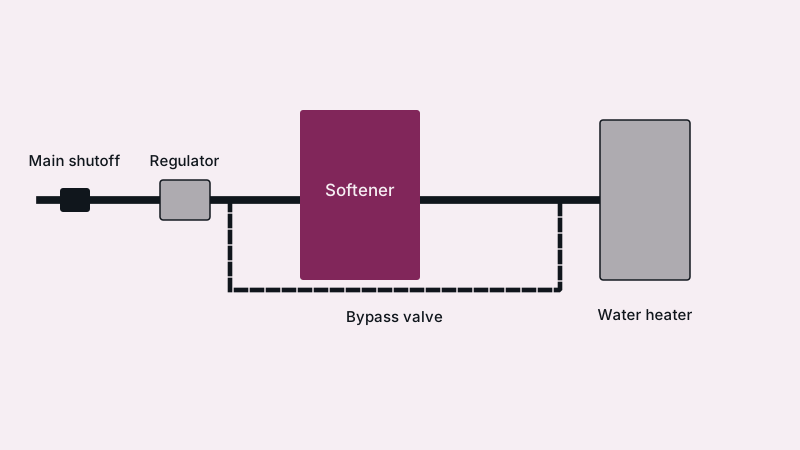
- Find the spot. Downstream of the main shutoff and the pressure regulator, upstream of the water heater, and ahead of the branch for the hose bibs so lawns and cars are not softened.
- Close the main, then run the lowest tap in the house until the line is empty.
- Cut into the line where the bypass will sit. Copper needs a tubing cutter and either push connectors or soldered joints. PEX uses crimp or clamp rings. Galvanized needs an adapter.
- Mount the bypass and connect the inlet and outlet hoses, observing the arrows on the valve head.
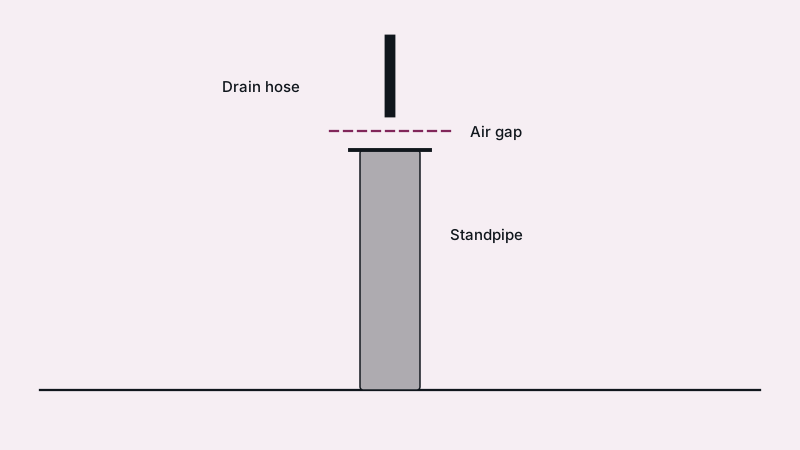
- Route the drain hose into the laundry standpipe, or a floor drain, leaving a gap of air so sewer water can never siphon backward.
- Load salt, plug in, program the hardness and time of day.
- Start up: put it in bypass, open the main slowly, purge air at a faucet, then switch to service and run a first regeneration.
Do not skip the two gaps: air gap at the drain and a service loop that lets you remove the head. Gas lines and electrical panels are not part of this job. If the nearest outlet is far, have an electrician add one.
What clears the scale that has already built up?
Dissolve it with vinegar or citric acid dissolved in water: soak the fixture until the crust softens, then wipe and rinse. A showerhead can hang in a vinegar-filled bag for about an hour. Never use acid on natural stone or on a water heater tank without the maker's directions.
For stubborn buildup:
- Swaddle a faucet base in a wet vinegar rag for an hour.
- Brush the plastic nozzles of a showerhead with an old toothbrush.
- Rinse well, because vinegar can dull some finishes if left on.
Scale inside the heater is another matter. A tank with heavy sediment is a case for a flush or a replacement, and our page on removing scale goes through the options. A softener installed after scale has formed prevents more, and slowly loosens some, though it will not clean pipes that are already crusted.
When is a professional install the better route?
Hand it off when the main line is galvanized or corroded, when no drain is within reach, when the HOA or city requires a permit, or when you want it done in a single visit. Typical bills for that route are in the softener installation prices page.
Once labor and materials pass $1,000, the contractor needs a California license. Owners may do their own home. Whoever quotes you, run their license number through the board's online lookup.
Regeneration also draws water, so the effect on your bill is worth a look in this softener and water bill explainer.
Common questions
Where on the line should the softener go?
After the main shutoff and the pressure regulator, and before the water heater. Branch off to outdoor spigots ahead of it so irrigation and car washing use hard water. Keep it near a drain and an outlet, and give the head room for service.
Will the water taste salty?
No, not noticeably. Ion exchange swaps calcium and magnesium for a small amount of sodium. The amount rises with hardness, and some people keep an unsoftened drinking tap in the kitchen. A reverse osmosis filter at the sink also removes most of it.
How often do I add salt?
Check the brine tank monthly and keep it at least a third full. Most households add a bag every few weeks. Use the salt type the manufacturer names, usually pellets. Avoid rock salt because dirt builds up at the bottom.
Can I install one on well or recycled water?
Mission Viejo homes use municipal supply, so well water is rare here. Recycled water lines, marked purple, serve irrigation only and must never be tied into a house softener. Keep the unit on the drinking-water supply, and ask the district if you are unsure which line you have.
Will a softener dissolve the scale already in my pipes?
It stops new scale from forming, and some owners report old deposits slowly softening. It does not strip heavily crusted pipes. If your faucets run weak because of scale, cleaning the aerators or replacing the worst sections of pipe is the realistic fix, and that falls to a trade professional.
This guide is one of many on Capistrano Plumbing plumber.
Sources
Updated