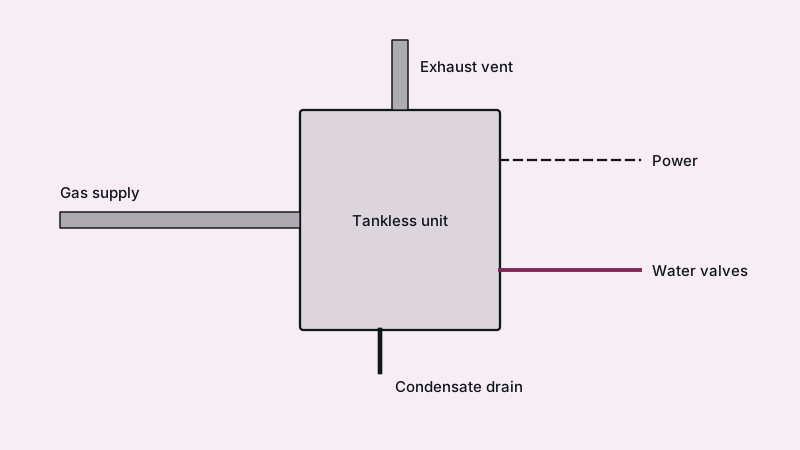
Think of a tankless installation as a utility upgrade with a heater attached. The unit is small and hangs on a wall, yet it burns gas far faster than a tank does, so the gas pipe, exhaust route, drain and power all need checking before equipment is bought. Still comparing options? The water heater service overview is the place, and replacement pricing covers money.
Which parts of the house change when a tank becomes tankless?
Four things: gas supply, exhaust, drain and wiring. The gas pipe may need to be wider. The exhaust leaves through a sealed vent. A condensing model sends acidic condensate to a drain. Every model needs electricity for its controls. Water lines usually gain service valves too, which make later descaling possible. Then comes testing, temperature setting and inspection.
The gas side usually decides the price. Rinnai's manuals say the supply must cover the entire gas load of the house, with sizing taken from National Fuel Gas Code tables that weigh pressure drop, supply pressure and pipe length. Some Rinnai condensing models are rated at 199,000 BTU per hour, and an older half-inch line may not carry that. How piping gets sized is explained in residential gas piping codes.
What do the codes ask for, and who pulls the permit?
Expect paperwork. Whoever files will want the gas pipe calculation, the heater's BTU rating and the vent plan. California's residential energy compliance manual (the 2019 edition) says new gas lines should be designed for 200,000 BTU per hour so a tankless unit can be added later, with three-quarter inch as the smallest water heater supply.
That advice is aimed at new construction. A Mission Viejo house from the 1960s to the 1990s is whatever its builder installed, so a plumber measures instead of assuming. The city's Building Services Division has a water heater handout online, and its fee schedule lists $75 per heater. Phone the division to learn how a tankless swap is treated at your address. Gas piping is reserved by California for contractors holding the matching license, so it is not an owner project. If you ever catch the smell of gas during the work, exit the house and use the utility emergency line, 1-800-427-2200. SoCalGas alone works the meter valve.
What sets a condensing tankless apart at install time?
A condensing unit extracts extra heat from the exhaust, so what leaves is cool enough to turn to acidic liquid. That liquid needs a drain, sometimes a neutralizer, and the manufacturer specifies the vent material, commonly stainless steel because of the acid. Rinnai says its condensing models must not share a vent with another appliance.
Rinnai's manuals add a condensate collector that must hold water before first use. Vent length and the distance to windows and property lines limit where the unit can sit, which is why garages and exterior walls are popular spots. Outdoor models avoid indoor venting; see outdoor tankless installation. Gas-side detail continues at gas tankless installation.
Gas or electric: which tankless is easier to put in?
Neither is simply easier. Gas needs a pipe and a vent. Electric needs no vent but pulls heavy current, and a panel upgrade can be the biggest line on the quote. In the Department of Energy's Building America guideline, an electric tankless at best saves about 12 percent of energy against an electric tank.
Where a home already has natural gas, a gas unit is the usual choice if the meter and pipe can carry it. The same guideline puts a tankless at roughly 1.5 to 2 times a tank's price up front, with yearly running cost anywhere from 5 to 40 percent lower depending on fuel and efficiency, and DOE materials give tankless units 20 years or more. HomeGuide lists gas tankless installs at $2,100 to $5,600, with vent, gas or panel work pushing toward the top. Treat that as a national guide, since the written quote sets your price.
What should I check if the new unit gives no hot water?
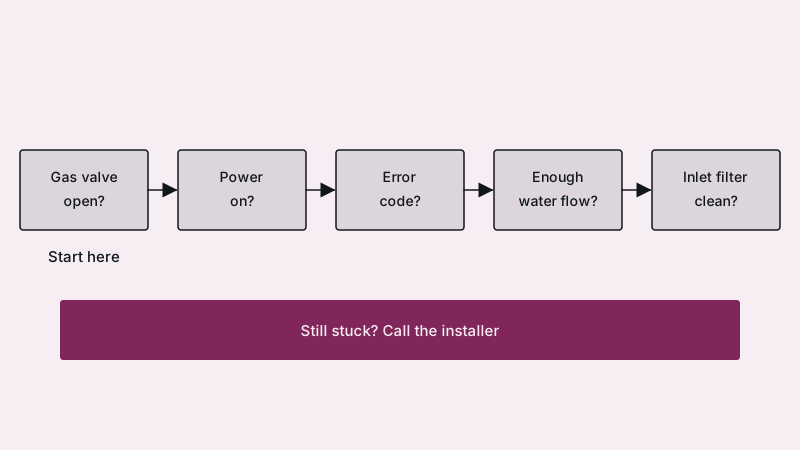
Start simple: is the gas valve open, is there power, does the display show an error code, and is enough water flowing, because several models will not ignite below a set flow rate? Then look at the inlet filter. A brand-new unit that throws a code is usually a gas, vent or setting problem, so the installer should return.
Scale gradually coats the heat exchanger when water is hard, and your water district's yearly quality report lists the hardness for your supply. Those service valves are what let a plumber circulate descaler through the unit. Hot taps with a cold house are a separate puzzle. Furnace and water heater run independently in most homes, so inspect the thermostat and furnace on their own, as in no hot water but heating works.
Why not do the installation myself?
Because a poor gas connection, undersized pipe or bad vent can leak gas or exhaust carbon monoxide, and California regulates the work. A contractor sizes the line, builds the vent, pulls the permit, schedules inspection and tests every joint. CSLB sets the point at which a contractor license becomes mandatory at $1,000 of work.
Check the license number with CSLB, and insist the quote lists the model, any gas pipe work, vent, condensate drain, wiring, permit fee and disposal of the old tank. Describe the setup through the price request page. Weekday requests, 9 to 5, are answered and a local plumber visits afterward. The Capistrano Plumbing home page lays out how that goes.
Common questions
Is my present gas line big enough?
Frequently it is not. Tankless units pull a lot of gas all at once, and a half-inch line is easily outmatched. The plumber measures the length, totals every gas appliance and sizes the pipe from code tables. Skipping that step leads to shutdowns or a unit that will not fire when demand peaks.
Will Mission Viejo want a permit?
Replacing any water heater is normally a permitted job, and the city's schedule has a line for it. Tankless work adds gas, venting and often wiring, so expect an inspection. Check that the permit is priced into the quote, find out who books the inspector, and call Building Services about anything unclear.
How long will the install take?
Where the gas pipe already suits, a straight swap can wrap up within part of a day. A larger gas line, another vent route or a panel upgrade stretches it. Ask for the expected time in writing, and plan for a day without hot water in case an inspection or a part is late.
What maintenance does a tankless heater need?
Flushing, mainly. Scale collects on the heat exchanger in hard water, and the inlet screen can clog. Isolation valves make flushing simple, and a plumber can descale the unit and check the vent and condensate drain. Neglect shortens the unit's life and cuts its output.
Could a handy owner swap it?
Not legally for the gas piping, which California keeps for contractors holding the right license, and not wisely for the vent. A permit and inspection apply. Leaks and carbon monoxide are real risks whatever an owner may be allowed to attempt. Get the job quoted and let the inspector sign off.
Sources
- DOE Building America, Measure Guideline: Transitioning to a Tankless Water Heater
- HomeGuide, water heater installation cost
- U.S. Department of Energy, Energy Saver guide
- California Energy Commission, 2019 Residential Compliance Manual, Chapter 5 Water Heating
- Rinnai, tankless water heater installation and operation manuals
- SoCalGas, How to Shut Off Your Natural Gas in an Emergency
- City of Mission Viejo, Building Services Division, water heater handout and fee schedule
Updated