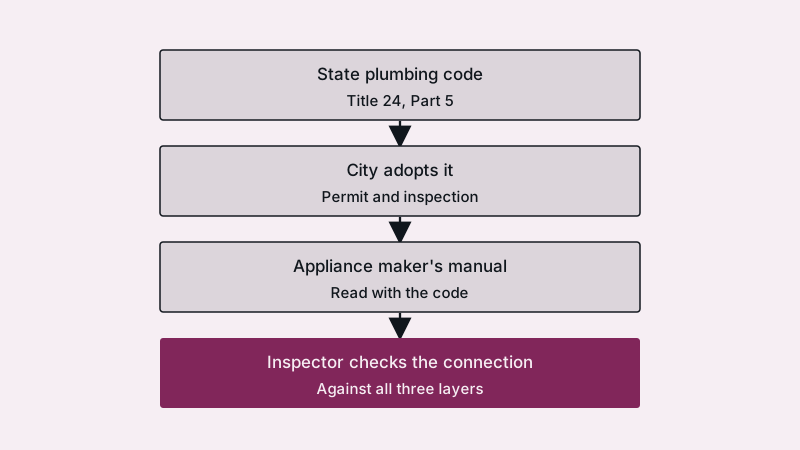
Part 5 of the state's building standards, Title 24, is the California Plumbing Code, and it sets the rules for fuel gas pipe in and around a Mission Viejo home. According to the state commission the 2025 edition has applied since January 1, 2026, and the city's Building Division puts it into practice through permits and inspections. A gas leak can start a fire or an explosion, so the rules are specific and the pipe work belongs to a contractor, as the gas plumber page describes.
What follows is a plain-language tour of the topics the code addresses. It does not stand in for the code text, whose tables we have not reproduced.
Which code applies to gas piping in my home?
The state plumbing code, published through IAPMO, covers fuel gas piping in homes, and it is read together with each appliance maker's installation instructions. Cities adopt it, sometimes with local amendments, and enforce it through their building departments. Mission Viejo's Building Division can tell you which edition and amendments apply at the time of your permit.
New editions arrive roughly every three years. The 2025 edition replaced the earlier one from January 1, 2026. If a contractor cites a section number, ask which edition it came from.
Appliance makers' instructions are part of the rules in practice. An inspector checks the connection against the maker's manual as well as against the code.
What does the code regulate about gas pipe?
Its topics are the materials allowed, how pipe is sized, joined, supported and protected, where valves sit, how appliances connect, and how the system is tested before use. The thread through all of it: pipe that carries the load, joints that cannot leak, and a way to isolate each appliance.
In plain terms, the main topics are:
- Materials. Approved pipe and fittings only. Common residential choices are steel pipe and approved flexible tubing systems, and each has its own installation rules.
- Sizing. Diameter comes from code tables that weigh what every appliance can burn at once against how far the pipe runs. Skimp on size and the burner starves the moment two appliances fire together.
- Joints and supports. Connections must be made with approved methods and supported so that the line cannot sag or be stressed.
- Shut-off valves. Each appliance needs an accessible shut-off, so it can be isolated without turning off the whole house.
- Appliance connectors. Flexible connectors have limits on length and where they may be used. See flexible gas lines.
- Protection. Pipe passing through walls, floors or exposed areas needs protection from damage and corrosion.
- Testing. Before gas flows, the piping holds a test pressure while the inspector watches for any drop.
Why does pipe sizing matter so much?
A pipe too small for its load shows itself when several appliances fire together. Sizing starts from what everything on the line can draw and how far the run is from the meter. Trouble tends to arrive after an upgrade: a tankless heater, a new range, a fire feature added to an old line.
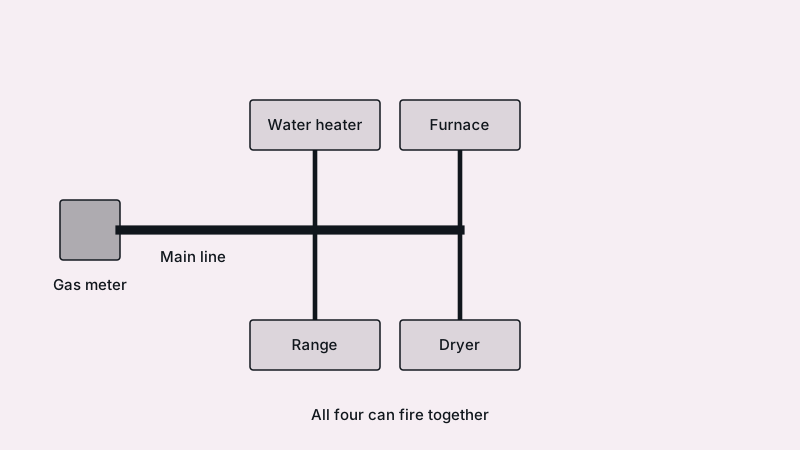
The plumber totals each appliance's input rating, measures the run, and looks up the pipe size in the code tables. If the existing line is too small, part of it must be replaced or a new branch run. SoCalGas owns the meter and decides whether the meter's capacity covers the new load, so ask it as well as the contractor.
Sizing questions come up in practice on the pages about gas tankless installation and outdoor tankless installation.
What happens at a gas pipe inspection?
The work is permitted, and an inspector visits at set stages. Piping is checked for materials, joints, supports and valve locations, then pressure-tested before it is covered or gas is turned on. Once appliances are connected, a final visit covers connections, venting and shut-offs. Your contractor books them.
Ask your contractor which inspections the permit requires and when, and keep the signed permit card or final approval with your house records. An unpermitted gas job can cause trouble at resale and with insurance.
We did not retrieve the City of Mission Viejo's published fee schedule or inspection stages, so we do not state fees. Call the Building Division, or look at the city's website, for the current rules.
Who is allowed to do gas piping work?
On paid work above $1,000, California expects a contractor holding the right classification, and cities can treat owner-done gas pipe as a permit matter too. Our advice is not to attempt it yourself; testing and inspection are there to catch mistakes early.
Ahead of signing, get the contractor's license number, check it on the state board's website, and agree who files the permit. Deposits on home improvement contracts have their own ceiling, so be careful with large up-front requests.
A gas smell near a pipe, appliance or meter sends everyone outdoors first, and the utility's emergency number, 1-800-427-2200, gets dialed from outside.
What do the codes mean for an earthquake valve or a gas line extension?
They govern where a valve may go, how it joins the piping, and how added pipe is sized, supported and tested. A seismic valve sits on the owner's piping, so it follows the same permit and inspection path. An extension adds load, which means the sizing check is repeated.
Valve types are compared in the seismic valve guide, the work itself is described under gas line plumbing, and gas line cost shows what moves a quote.
Common questions
Which edition of the California Plumbing Code is in effect now?
Edition 2025, which the state Building Standards Commission lists as taking effect on January 1, 2026. Cities may add amendments, so ask the City of Mission Viejo Building Division when applying, and ask the contractor which edition governs your job.
Does adding a gas range or dryer outlet need a permit?
Typically, because any new branch or altered pipe is permit work, and the contractor normally files. Confirm with the City of Mission Viejo Building Division for your address. Even swapping one appliance for another, a water heater for example, may trigger a permit and an inspection.
Can I use flexible gas pipe in my home?
Approved flexible gas piping and connectors are allowed in many situations, but each type has rules about length, location, support and protection, and must be installed to the maker's instructions. A plumber should confirm the product suits your installation and that the inspector will accept it.
Why must gas lines be pressure-tested?
A pressure test shows whether the joints hold before gas flows. A leak found with air or inert gas under test is a nuisance. A leak found with natural gas is a fire risk. The inspector witnesses or checks the test before the piping is covered or the gas is turned on.
Does the newest code force me to rebuild old gas pipe?
We could not confirm a rule that forces existing, previously permitted piping to be upgraded on its own. Changes usually bring the new work, and sometimes related parts, under the current edition. Ask the City of Mission Viejo Building Division what applies when you apply for a permit, and keep your old permit records handy.
For the wider picture, start with Mission Viejo plumber.
Sources
Updated