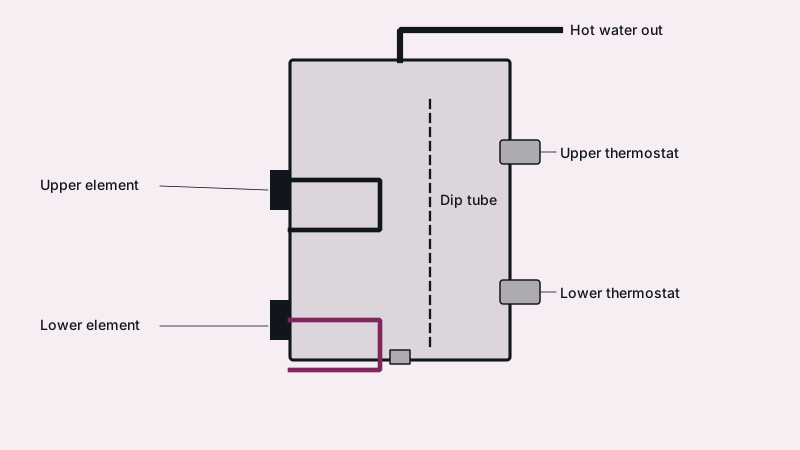
A failed heating element is a common reason an electric tank starts hot, fades to lukewarm within minutes, or never warms up. The part itself is a screw-in or bolt-on coil that is cheap to buy, and the work is mostly safety: power off, tank drained, then swap. When anything looks wrong, the water heater repair page shows the other ways a tank can fail.
Is it the element or the thermostat that quit?
Your symptom narrows the field. Cold all the way through suggests the upper element or its thermostat, since the upper one heats first. A short supply of hot water suggests the lower element. A breaker that pops each time the heater calls for heat suggests a shorted element. Only a meter test settles it.
With the breaker off, remove the access panels and insulation, and use a non-contact voltage tester to prove the power is dead. Disconnect the two wires from the element terminals and set a multimeter to resistance. A healthy 4,500-watt element usually reads somewhere around 10 to 15 ohms. A reading of infinity means a burned-out coil, and a reading of zero from a terminal to the metal flange means the element has grounded out. Check the label on yours, because wattage varies.
The no hot water on an electric heater guide runs the same diagnosis in order, and starts with the reset button on the upper thermostat. Do that before buying anything.
Which replacement element do I buy?
Four things must match: voltage (240 for nearly every home tank), the wattage on the old element or data plate, the mounting (a screw-in with a hex head, or a four-bolt flange), and the length, since some tanks take a short or low-density type. Bring the old one shopping, or read the stamp on its base.
Do not raise the wattage to chase faster recovery. The wiring and the thermostat are sized for the original element. The heater's data plate lists the allowed wattage. Low-density elements cost a little more and last longer in scale-prone water, which is worth considering here, since the local utility's water-quality reports show hard water. Moulton Niguel Water District, one of the districts the city lists, has reported hardness between roughly 13 and 17 grains per gallon in several recent years. Scale bakes onto the element surface and burns it out.
Is this a job a homeowner can do safely?
It is possible if you can prove power is off, empty part of the tank and handle 240-volt wiring. The risks are shock, scalds from hot tank water and a weeping gasket after reassembly. If any step feels shaky, or the heater sits in a tight closet, let a plumber do it.
Steps in order:
- Switch the breaker off and confirm with a tester at the element terminals.
- Close the cold supply and open a hot faucet in the house so air can replace the draining water.
- Connect a hose to the drain valve, route it outside, and lower the water under the element, or empty the tank for the lower one.
- Take off the wires, then unscrew the element with an element wrench or undo the flange bolts.
- Clean the gasket seat, fit the new element with its gasket, wire it back and tighten.
- Refill with that hot faucet open until a steady stream runs, and only then restore the breaker.
The order of step 6 matters. Powering an element that is not submerged burns it out in seconds, and a dry-fired element is the leading reason a new part fails at once.
What is the plumber bill for an element swap?
The part is the smaller piece of the bill. No sourced price for the visit turned up, so none is printed here. Adding a new thermostat, a tank flush or awkward access raises it. You see the quote in writing before work starts.
Weigh it against the tank's age. Past ten years with rust at the base, a new element buys little time. Read how often a water heater should be replaced and electric water heater replacement costs before spending on an old tank. The element job does not normally need a city permit, since it is a repair of an existing appliance, but replacing the whole heater typically does. The city's Building Services Division can confirm for your address.
Why do elements keep burning out?
Mineral scale and dry firing are the two big causes. Limescale coats the element and insulates the coil, so it runs hotter and burns out. Sediment heaped on the floor of the tank buries the lower element. A tank that runs dry while powered, after a repair or a draining, burns elements immediately.
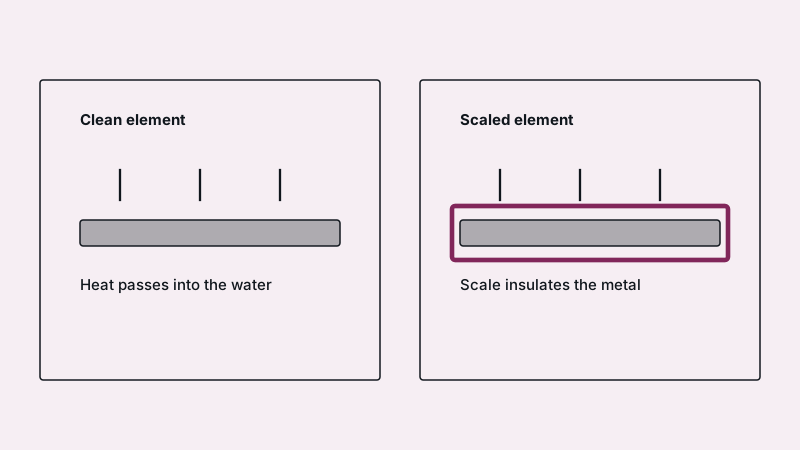
A yearly flush, plus a fresh sacrificial anode when the old one is spent, slows the damage. The anode rod replacement page explains that part, while preventing hard water scale handles the mineral side. A bad element can also run the heater harder than it should: see whether a broken heater raises your electric bill.
Common questions
Should I replace both elements at once?
Often, yes. If one burned out from scale, the other has been through the same water and the same hours, and you have already drained the tank. Replacing both costs one extra part and saves a second drain later. A clean lower element in a young tank can stay.
How long does an element last?
It depends on water hardness and use, and a range of several years to a decade is common, shorter in hard water. A burned-out element in a tank under five years old suggests scale or dry firing. An old tank that has already lost its anode may corrode before a new element pays back.
Is a leak around the element a problem?
Yes. Water weeping at the flange means a bad or reused gasket, or a cracked tank at the mounting. Switch the power off. Replace the gasket and retighten; if it still weeps, the tank is likely failing and a leak can wet insulation and wiring. A pressure relief valve that drips is a different issue.
Can I use a gas water heater element?
Gas tanks have no heating elements. They use a burner and a thermocouple, so this page applies only to electric heaters. If you are unsure, the data plate lists the fuel, and gas tanks have a vent flue and a gas line at the bottom.
Which situations call for a plumber instead?
Whenever proving power is off feels unfamiliar, sediment has clogged the drain valve, a flange bolt will not turn, or the tank leaks. Also call if the new element trips the breaker straight away, which points to wiring or a thermostat fault, not a bad part.
This guide is one of many on Capistrano Plumbing.
Sources
Updated