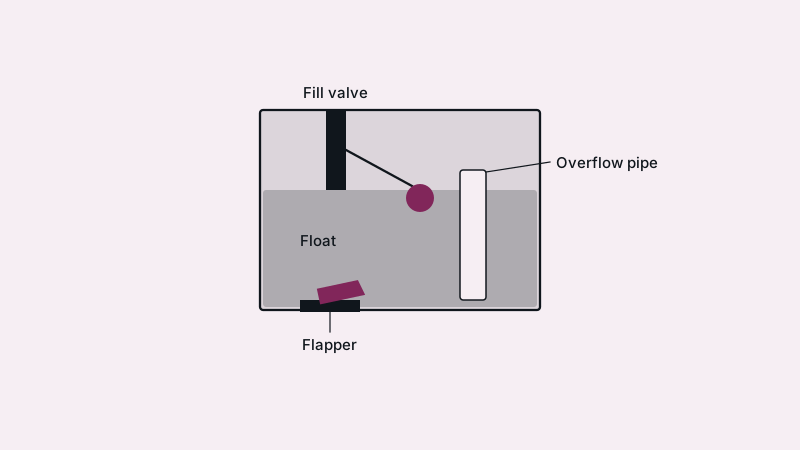
Lift the tank lid and listen before you touch anything. Trickling suggests the flapper, a steady hiss suggests the fill valve, and a refill every quarter hour with nobody near the bathroom means the tank is losing water to the bowl. The cure is usually an inexpensive part and thirty minutes. When it is not, our toilet repair services cover a plumber visit, which you can start from the quote request.
Can the toilet's behavior point to the broken part?
Treat the behavior as a clue sheet. Silence between sudden refills points at the flapper. A constant hiss with a full tank points at the fill valve. Water sliding into the overflow tube points at a float set too high. Each has its own repair, so naming the culprit first saves buying the wrong kit.
| Behavior | Prime suspect |
|---|---|
| Tank tops itself up every 5 to 30 minutes | Flapper no longer sealing |
| Hiss that never ends, tank looks full | Fill valve stuck open |
| Thin stream down the overflow pipe | Water level set too high |
| Handle has to be held to finish a flush | Chain too tight or too loose |
| Keeps running only after a flush | Flapper caught open by its chain |
How can dye show whether the flapper leaks?
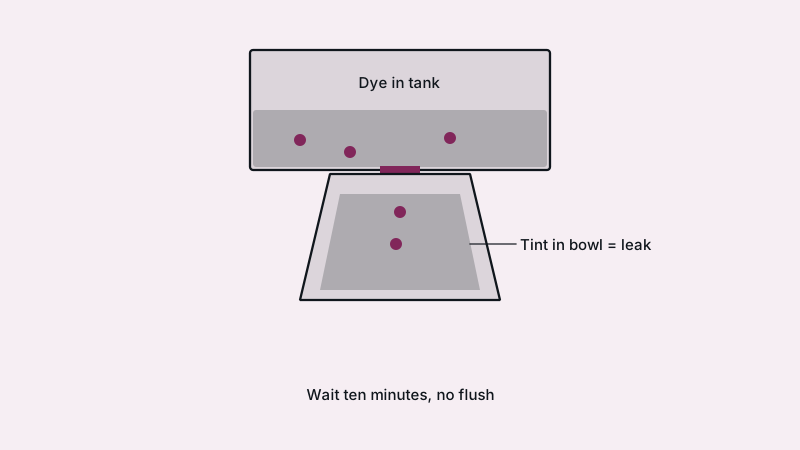
Squeeze some food coloring into the tank, step away and let ten minutes pass with no flush. Then look into the bowl. Any tint there proves water is sneaking past the seal. That is the leak check EPA recommends. Flush when the test is done, or the dye will stain the tank.
Wikipedia's toilet entry observes that flappers commonly start leaking after a couple of years, from wear and trapped grit. Replace it with an identical style, and look at the flush valve opening for the size, because openings come in more than one diameter. A step-by-step version is in toilet flapper repair.
What does a failed fill valve look and sound like?
Picture a full tank, the surface sitting lower than the overflow pipe's rim, and a hiss that never ends. The valve has stopped closing. Grit and scale are common causes in south Orange County, where the supply is hard and mineral flakes lodge in the seal or on the float arm.
Close the stop valve under the tank, flush to drain it, and swap the whole valve assembly, which is held by one nut under the tank. Tighten the supply connection by hand and no more, because plastic cracks. The walkthrough for that job is repairing a toilet fill valve. A stop valve that refuses to turn is a signal to put the wrench down and phone someone.
Why does the tank keep emptying into the overflow pipe?
The level has been set above the pipe's rim, so the tank spills its extra into the bowl all day. Adjust the float by turning the screw on top of the valve, or sliding the clip along its rod, until the surface rests roughly an inch under the rim, then let the tank fill and watch that it stops.
A level that is already low yet still runs shifts blame to the valve. Check the pipe with a flashlight for hairline cracks. If it is cracked, the entire flush valve must be replaced, which suits a plumber, since the tank must be separated from the bowl first.
Will the bill reveal a toilet that never stops?
It will, slowly. A tank that refills several times an hour burns through gallons while nobody notices, and the EPA estimate for a typical home's leaks, above 9,300 gallons yearly, counts sources exactly like this one. Expect the monthly total to creep up before it jumps.
Many Orange County water districts bill in usage tiers, so a silent leak can push a household into a pricier one. Doubt the toilet is the cause? Read the water meter with everything turned off, wait a couple of hours, then read it once more. Any movement is a leak somewhere. Wider bill puzzles are tackled in high water bills explained.
At what point is this no longer a tank-parts job?
When the evidence lives below the tank. A damp floor around the base, a bowl that rocks, a cracked tank, or bubbling after other drains run points toward the wax seal, the floor flange or the drain. Those repairs begin with unbolting the toilet from the floor.
Hand it over, too, when the angle stop at the wall refuses to close, the supply line shows corrosion, or one honest attempt with new parts changed nothing. A plumber can replace the internals as a matched set, ensuring everything fits together. If the toilet is ancient and keeps failing, a new toilet may cost less than repeating repairs.
Is this a cheap repair, and how long does it take?
Flappers and fill valves are inexpensive hardware-store parts, so a do-it-yourself repair is often a half-hour job. We found no sourced figure for a plumber visit, so none is printed here, and the written quote sets the price. Naming the failed part when you call helps the plumber bring the right kit.
Buy the part only after you have named the culprit. Take a photo of the tank internals and the brand name on the fill valve, which makes matching easier at the store. If the toilet is a 1.6-gallon model from the 1990s, check that the replacement flapper suits that older tank, since a poor match can leak or flush weakly.
Common questions
The toilet runs for a while after flushing and then quits. Why?
Usually the chain. If it is too short, or tangled, the flapper stays propped open until the tank empties enough to drop it. Untangle it and leave a little play, no more than half an inch. If the problem returns, the flapper is warped and a fresh one will seat evenly.
Should I treat a running toilet as urgent?
Not urgent, but do not let it sit. Waste accumulates, and a faulty valve can eventually overflow the tank. When water reaches the bowl's rim or drips on the floor, close the wall valve and call. Otherwise shut the valve overnight and repair it the following day.
Do the valve and flapper deserve replacing as a pair?
For a toilet beyond its first few years, yes. The two wear at a similar rate, and a combined kit costs little. One shutoff, one visit, and you will thank yourself when it stays quiet. Pick a kit that matches your tank brand and flush valve size.
Can mineral buildup make a toilet run?
It contributes. Scale roughens the flapper seat and clogs the valve's diaphragm, so seals leak. Hard water is common around Mission Viejo, and wiping the seat with white vinegar sometimes cures a mild case. Persistent crust is a bigger issue; see hard water scale prevention.
This guide is one of many on Mission Viejo plumber.
Sources
Updated