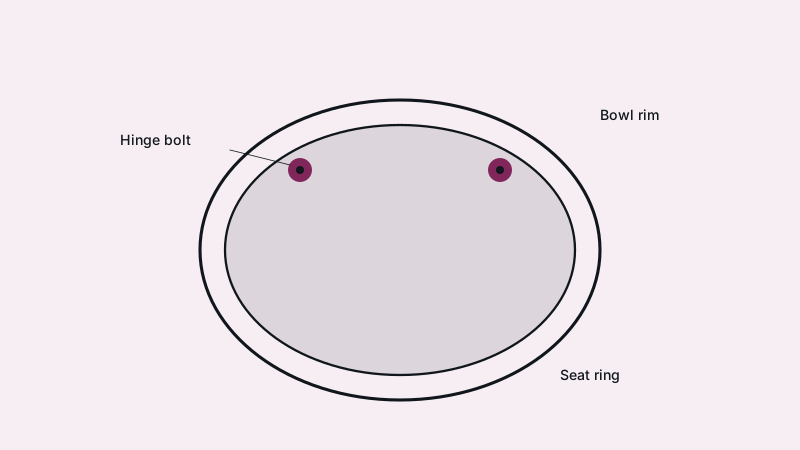
Most wobbly seats need one thing: firmer hinge bolts at the back. A screwdriver does it, sometimes with a small wrench. Bolts that keep loosening mean worn plastic nuts or hinges, and fresh hardware or a new seat ends the cycle. When the whole toilet moves, not just the seat, head for toilet repair.
What makes a toilet seat wander sideways?
Either the two bolts passing through the bowl's rear holes have backed off, or the nuts beneath have worn or split. Daily use pushes the hinges sideways, and plastic threads do not hold forever. Loose seats rarely mean the toilet is faulty. They mean small hardware has given up.
Check three things: whether the hinge bolts turn freely without gripping, whether the rubber or plastic bushings are squashed or missing, and whether the seat's mounting holes are oversized and sloppy. A bolt that spins but does not tighten has a stripped nut or is turning inside a cracked plastic sleeve. A seat that was never the right shape for the bowl also slides, as round seats on elongated bowls do.
How do I tighten a seat that screws in from the top?
Flip up the plastic caps over the hinges, grip the nut underneath with fingers or a wrench and turn each screw clockwise until the seat stops shifting. Square the seat on the rim first, then bring both sides up evenly. Firm is enough, since forcing it can crack plastic or porcelain.
Step by step:
- Raise the seat and lever each hinge cover open with a flat screwdriver.
- Find the slotted screw or bolt head underneath.
- Reach behind the bowl and pin the nut still.
- Turn the screw until it grips, seat centered.
- Snap the covers shut and shove the seat sideways to test it.
On designs with a wing nut under the bowl, finger-tight plus a small extra nudge is enough.
What about seats fastened from underneath?
On a bottom-fix seat the fasteners hide below the rim. Reach behind the bowl, find the two plastic wing nuts or wing screws, and turn them clockwise by hand while a helper keeps the seat centered. These systems usually include a quick-release for cleaning, and the quick-release hardware can be the part that loosens.
If the seat slides after you tighten the nuts, the issue is usually that the rubber bumpers are worn and the seat is not squarely gripped. Slide a washer or a new rubber bumper into place if the kit has one. If your seat has a metal hinge, keep both nuts at the same tightness so it does not twist. A seat that tilts at the back suggests only one side is holding.
The bolts just spin. Now what?
Pinch the nut under the bowl with pliers while turning the screw, or swap the hardware. A stripped plastic nut spins freely, and a fresh nut and bolt set costs little. Stainless or brass hardware outlasts plastic, but too much force can crack porcelain, so stop the moment the seat is still.
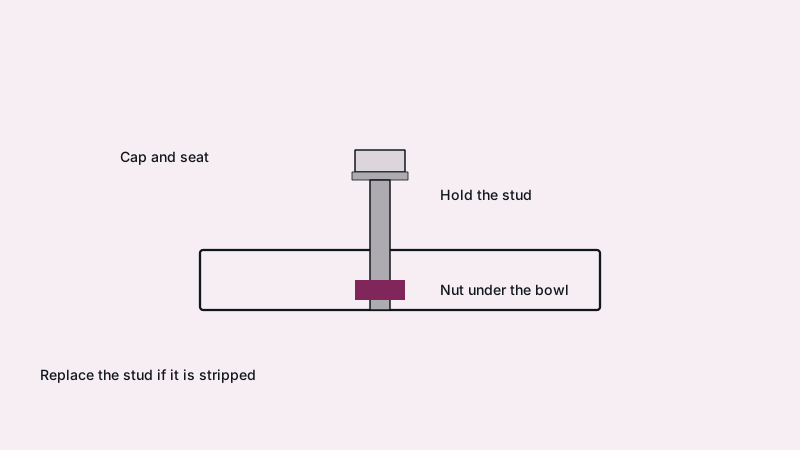
When the nut is stuck or corroded, which happens in humid bathrooms, spray a penetrating lubricant on it, wait, and hold the screw as you turn. Take a photo of the setup before removing anything. If a bolt snaps, a hacksaw blade cuts through it, but put cloth under the blade to protect the porcelain. Stop if the bolt turns the toilet's own mounting. Those are different bolts that belong to the base.
When is a new seat smarter than a repair?
A new seat wins when hinges are cracked, the seat is warped or chipped, the finish is peeling or the hardware is too worn to grip. Seats are cheap, and a proper fit costs little more than a repair kit. Match the shape, round or elongated, and the spacing of the bolt holes.
Measure the bowl: rear holes to the front rim, and its widest width. Hole spacing is commonly 5.5 inches center to center, though bowls differ, so measure yours. Soft-close seats cost more and loosen too, so recheck after a month. Even a pricey seat is minor next to a new toilet, which our toilet replacement cost page prices out.
Is it the seat wobbling or the bowl itself?
Sit, lean from side to side and watch the base. A bowl that rocks on the floor has a problem below the hinges. A moving toilet can break its wax seal and leak into the subfloor, so stay off it until it is secured, and see toilet leak repair.
Toilets are held to the floor by two closet bolts, one each side of the base, usually under snap-off caps. They can be tightened, but gently, one side then the other in small steps. The flush toilet depends on a sealed joint to the drain, as Wikipedia's description of the fixture implies, and rocking breaks that joint. If tightening does not stop the movement, the wax ring or the flange beneath needs attention, which is plumber work. Water around the base, a sewer smell or a soft floor are all reasons to book that visit.
When does this become plumber work?
A seat alone needs no plumber. Call one when the base rocks, water shows at the floor, the closet bolts are corroded or broken, or no seat will hold. Expect the toilet to be lifted, the flange inspected and a fresh wax ring set.
Describe the job through the quote request. The quote should itemize the ring, bolts and any flange repair. CSLB expects a written contract once home improvement work passes $500, so ask for paper on a larger job. While the plumber is there, ask about the fill valve and flapper, because a running toilet can waste water, and EPA says toilet leaks usually come from worn flappers. The running toilet article helps with that.
Common questions
How much force do seat bolts need?
Enough that the seat resists a sideways push, and no more. Porcelain and plastic crack under heavy force. Firm by hand with a small extra turn suits most hardware. A seat that still slides needs a fresh nut or bushing, not another turn.
Why does a new toilet seat come loose so fast?
The usual cause is a mismatch. A seat sized for a different bowl, hinge bolts that sit in oversized holes, or bushings that were left out will all slide. Check that the shape matches and that every washer in the kit is installed. Re-tighten after a week, since new plastic settles.
Can I use a bottom-fix seat on a bowl with top-fix holes?
Often yes, because both attach through the same two holes. The difference is how the fastener grips from underneath. Some bowls have narrow or slotted holes that suit one design only, so check the package for fit before you buy and keep the receipt.
Does a wobbly seat point to a plumbing fault?
Not alone. The seat is not part of the plumbing. It matters only if you also see the bowl move, water at the base or a wobbling tank, which point to the mounting, the wax ring or the tank bolts.
This guide is one of many on Mission Viejo plumber.
Sources
Updated