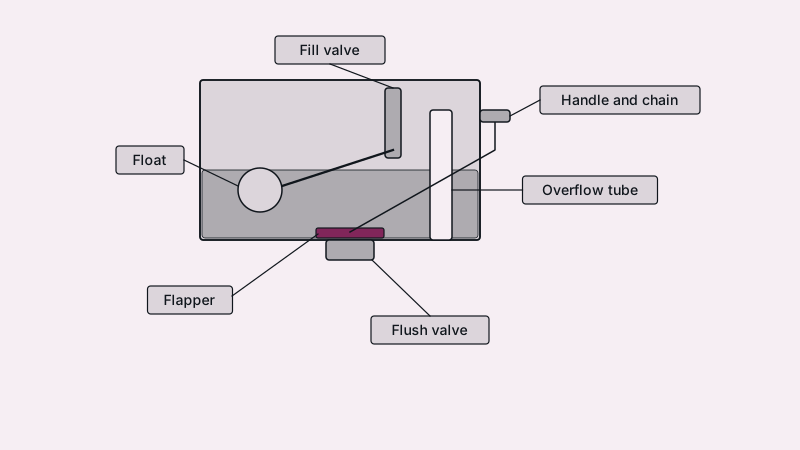
Lift the tank lid and watch one flush. A handle that feels loose points to the handle arm or chain, a flush that dies halfway points to the flapper or flush valve, and a tank that refills too low or too high points to the float. This guide goes part by part, and the toilet repair service page picks up where home fixes end.
What makes a flush weak or stop partway down?
A weak flush means the tank is releasing less water than the bowl needs, or releasing it too slowly. Usual suspects: a tank filled too shallow, a flapper that drops early, a chain with the wrong length, or crusted rim jets. Start with the level and the chain, which cost nothing to adjust.
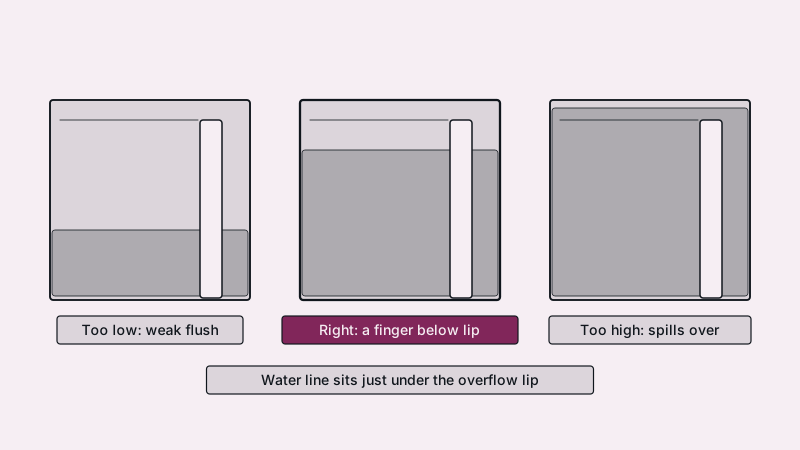
Mark the fill line inside the tank. Aim for the waterline roughly a finger-width under the lip of the overflow pipe; sit lower and the siphon runs short of fuel. Next the chain, which wants a bit of play, say the width of a thumb, so the flapper lifts all the way and drops cleanly. A taut chain props the flapper ajar. A floppy one barely moves it.
If both check out, peer at the jets under the bowl lip with a small mirror and flashlight. Scale from hard water can plug those jets, a common find in south Orange County bathrooms, and a bent wire or small brush frees them.
My handle wobbles or does nothing. What now?
Open the tank and look at what the handle moves. A handle that spins freely has a slack mounting nut inside the tank. On most toilets that nut is reverse-threaded, so it tightens counter-clockwise. A handle that moves but does nothing has a disconnected or snapped chain or arm. Reconnect the chain to the arm, or replace the handle kit.
Handle kits fit most tanks and cost little. Match the mounting position, whether front, side or corner, and the finish. Take off the old handle, thread the new arm through the hole, tighten the nut, and clip the chain through the hole in the arm that leaves the slack described above.
Could the flush valve itself be failing?
Look at the tank floor for the flush valve, the big outlet topped by the flapper, with the overflow tube rising next to it. A flapper that looks perfect while water still trickles into the bowl, or a toilet that keeps running after each flush, suggests a worn seat or valve. Replacing the valve means removing the tank, so many people hire out that step.
Test it with the supply closed. Press the flapper down hard with a fingertip. If the leak stops, it was the flapper, a cheap fix covered at toilet flapper repair. If it continues, run a finger around the rim of the valve seat. Mineral crust or pitting means the seat leaks and the valve assembly should be replaced.
A leak you cannot hear can still waste water. The EPA recommends a dye test: drop some food coloring into the tank, nobody flushes for ten minutes, and color reaching the bowl means a leak. Leaks of every kind cost the average household over 9,300 gallons yearly, by the agency's count.
What about the float and fill valve?
The float controls the fill valve, which sets the tank level between flushes. A float set too low leaves too little water for a strong flush, and one set too high lets water spill into the overflow tube. A cup-style float adjusts with a clip or screw, while an arm-style float bends or has a nut at the arm. Adjust a little at a time, then flush.
If the fill valve hisses constantly or will not shut off even after adjusting, replace it. A fill valve is the most common part swap, and instructions are on the repair a toilet fill valve page. The related symptom of water running after the flush is covered by the toilet keeps running guide and fixing a running toilet.
Is it time to replace the toilet instead?
A cracked bowl, a base that rocks and leaks, or repair after repair on a 1980s or early 1990s model all point to a new one. Those older bowls drink far more per flush than WaterSense-labeled models, which top out at 1.28 gallons. A new one usually flushes more reliably too.
Check the date stamped inside the tank, usually near the rear. If it predates the early 1990s, a replacement saves water and fixes weak flush performance at once. Parts for older models can be hard to find, while universal kits fit most newer ones. What replacement costs is in the toilet replacement cost guide. A rocking seat or wobble might only be loose bolts, covered in the loose toilet seat guide, while seepage at the base is another problem again, in repairing a toilet leak.
Common questions
Do I need special tools to fix a flush at home?
No for handles, chains, flappers and floats: pliers and an adjustable wrench do it. Close the wall valve, flush the tank empty, and photograph the layout before removing anything. The safer call is a plumber if the tank must lift off, the bolts are corroded or the shutoff will not close.
How long will the repair keep me busy?
A chain, handle or flapper is a half-hour job. A fill valve runs about an hour. A flush valve, which means lifting the tank off, can stretch to two hours. Common parts can ride along on the truck, while an unusual brand may need a second trip once the right part is found.
The toilet will not flush at all. Where do I start?
Look at the handle arm and chain, as a snapped chain is the usual reason for a dead handle. If the bowl is full or creeping up, hold off and look for a clog before another flush, since a blocked toilet can overflow. Close the wall supply valve by turning it clockwise if the level keeps rising.
Must replacement parts match the toilet brand?
Universal flappers, fill valves and handles suit most toilets, but flapper size, two inches or three, matters. Take the old part along when shopping, or write down the brand and model stamped inside the tank. A mismatched flapper often seals badly and recreates the very problem you are chasing.
Which flush faults are for a plumber?
Water that refuses to stop, the base leaks, the flush valve itself must go, or a fault that returns despite a fresh part. Ensuring the supply valve works before you start is wise, because a stuck one can flood the floor. Put the symptoms into a quote request and a visit gets arranged.
For the wider picture, start with plumber in Mission Viejo.
Sources
Updated