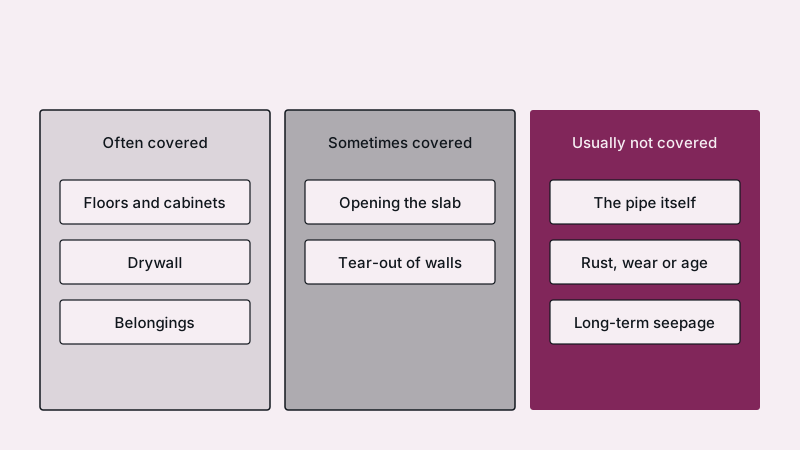
Short version: a typical homeowners policy treats a slab leak in two parts. The sudden damage it causes, such as soaked flooring, may be covered. The worn-out pipe and the slow leak that ran for months usually are not. Some policies also pay to break open the floor or wall to reach the pipe. Every policy words this differently, so the answer for your house is in your declarations page and your insurer's reply. This page explains the common patterns and what to do first. For the plumbing side, see leaks and burst pipes.
What do homeowners policies usually pay for after a slab leak?
Most standard policies pay for water damage to the house and belongings that arrives suddenly and by accident, and some add money for the tear-out needed to reach a leaking line. They usually do not pay to repair or replace the pipe that failed. Gradual leaks, corrosion and wear are commonly excluded, so a leak found after months of seepage may be denied.
Think of the claim as three separate lines:
| Line | Often covered? |
|---|---|
| Water damage to floors, cabinets, drywall and belongings from a sudden release | Often yes |
| Opening the slab or wall to reach the pipe (access or tear-out) | Sometimes, depends on the policy |
| The pipe itself, rust, wear or age | Usually no |
That split is why two neighbors with slab leaks can get different answers. Go through the water damage wording and the exclusions list, and hunt for any endorsement that adds water backup or "tear out" coverage.
Why do insurers deny slab leak claims?
The common reasons are wear and tear, long-term seepage and settlement. Weeks of dripping under the slab read as neglect to an adjuster, not as an accident. Many policies exclude continuous or repeated leakage over a period of time, and foundation movement is excluded or limited as well.
What helps a claim: proof of when the problem began. Water bills before and after, a meter test and the plumber's written finding all show whether the loss was sudden. EPA's household figure shows how invisible leaks pile up: more than 9,300 gallons yearly for the typical household. A jump in your own bill is evidence.
What are the first moves if I think the slab is leaking?
Close the main water valve, photograph every wet area, and phone both your insurer and a plumber. If a room is soaked and the breaker box stays dry and reachable, cut the power to that room. Most policies expect you to keep the loss from growing, and waiting can hurt the claim.
Clues that point under the slab: a floor patch that feels warm, hissing when every tap is shut, a meter dial that keeps turning while the house is idle, or a bill that climbs for no reason. The repair choices sit in slab leak: fix or repipe.
Standing water around outlets or the panel is an electrician's problem. Stay out of the room until power is off.
Does a burst pipe in a wall or ceiling get treated differently?
Often yes. A pipe that suddenly bursts inside a wall is the textbook case of covered sudden damage, while a slab leak under the floor leans toward the slower, hidden category. Even so, the failed pipe is still your cost, and the drywall, insulation and flooring it ruined are the part that may be paid.
Detail on the wall case is in burst pipe insurance, and the foundation angle has its own page, pipes broken under the foundation. Stains overhead are covered in ceiling damage after a leak.
How do I get a plumber's report my insurer will accept?
Ask for a written diagnosis that names the location of the leak, the method used to find it, the pipe material and condition, and the likely cause. Include photos. A leak found with electronic or acoustic detection has a clearer record than a guess. Keep invoices for the detection too, because some policies reimburse it.
Detection is a separate step from repair. Prices for it are in the leak detection cost guide. If the finding shows the pipe was old copper with pinholes, it helps to understand why, and the page on copper pinhole leaks covers the typical cause.
What are the claim deadlines in California?
California's claim regulations give insurers 15 calendar days to acknowledge a claim, and no more than 40 calendar days after proof of claim to accept or deny it. After acceptance they must pay within 30 days. A denial has to come in writing, list its reasons, and tell you the state Department of Insurance will review it on request.
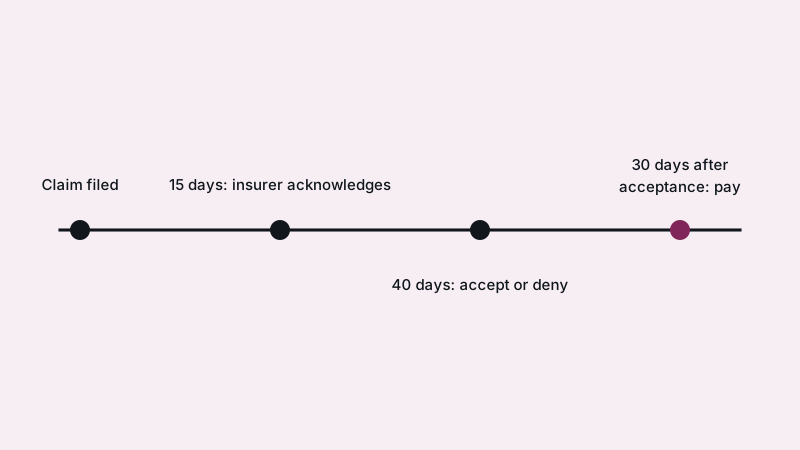
If your insurer asks for more time, it must say so in writing and explain why. Keep a log of every call and every email. If you disagree with a denial, ask which policy language was used, then take it to the California Department of Insurance. Large claims sometimes justify a public adjuster or an attorney.
Is a slab leak repair worth claiming when the damage is small?
Sometimes not. A claim may raise premiums or affect renewal, and a small loss can fall under your deductible. Ask your agent about your deductible and about how claims are recorded before filing, then decide. Do not skip reporting a large loss because of this fear, since late notice can be used against you.
Common questions
Does insurance pay to reroute pipes instead of breaking the slab?
Seldom in so many words. Some policies pay a reasonable cost of access, and a plumber may propose running a new line overhead to avoid cutting concrete. Before work begins, ask the insurer in writing whether that counts as access, repair or an upgrade.
Can I start repairs before the adjuster visits?
Stop the water and cover what you can, but photograph and keep damaged materials first. Major repairs before the insurer sees the loss can complicate the claim, so call early and ask what to preserve. Emergency steps that prevent further damage are normally expected.
Would a home warranty plan cover this instead?
It is a different product. A warranty plan is a service contract with its own terms, and slab leaks are frequently limited or excluded. Homeowners insurance responds to sudden damage under a policy. Read whichever you hold, and do not assume one stands in for the other.
Does any of this change in a condo or a rental?
It does. A condo association's master policy may cover the structure while your own policy covers interiors, and the governing documents decide who fixes what. Tenants rely on the landlord's policy for the building and their own renter policy for belongings. Report the leak to the landlord or HOA in writing straight away.
Does the city need to know about the repair?
Work that cuts a slab or replaces pipe usually calls for a city permit from the building department. Anything over $1,000 in labor and materials must go to a contractor holding a California license. Find out from the plumber who applies for the permit.
For the wider picture, start with plumber mission viejo.
Sources
Updated